
Free GCSE Science Revision: Free Resources vs Paid Platforms
Free GCSE Science revision resources can provide strong explanations, topic summaries and exam-board materials. Whether students need a paid platform depends on how independently they can organise their revision, identify weak topics, practise exam questions and correct mistakes.
Free resources are not simply a cheaper version of paid support. Official specifications, past papers, mark schemes, revision websites and videos can form an effective revision system when students use them actively and consistently.
The real difference is usually not access to information. It is how much structure, feedback and accountability the student needs.
What Free GCSE Science Resources Do Well
Free resources give students access to a large amount of useful GCSE Biology, Chemistry and Physics content without requiring parents to pay for a subscription.
The strongest free resources include:
- Official exam-board specifications
- Past papers and mark schemes
- Topic explanations and revision notes
- Revision videos
- School worksheets and lesson materials
- Free quizzes and retrieval questions
Specifications are particularly important because they show students what they may be assessed on. Students should first confirm whether they study AQA, Pearson Edexcel or OCR, whether they take Combined Science or separate sciences, and whether they are entered for Foundation or Higher tier.
Past papers and mark schemes then allow students to practise applying their knowledge. They also expose common problems such as misreading command words, omitting calculation steps or giving vague scientific explanations. Our guide to GCSE Science exam mistakes explains how these errors can reduce marks even when a student understands the topic.
Free resources are also flexible. Students can revisit a difficult idea, watch an explanation at their own pace or complete a short revision task around school and other commitments.
When Free GCSE Science Revision May Be Enough
Free GCSE Science revision may be enough for students who can manage the entire revision process independently.
This means being able to:
- Identify the correct exam board, qualification and tier
- Use the specification to check topic coverage
- Follow a realistic revision timetable
- Retrieve information without looking at notes
- Complete exam questions regularly
- Mark answers honestly using the mark scheme
- Correct mistakes rather than only recording a score
- Return to weak topics until performance improves
- Use official exam-board materials alongside revision websites
An organised student might learn a topic from school notes or a free video, close the resource and write down everything they can remember. They could then answer exam questions, mark their work and create a short list of errors to review later.
That is a valid and effective revision process. Paying for another resource would not automatically improve it.
Free websites such as BBC Bitesize can also be useful for reviewing key ideas. However, students still need to test whether they can recall and apply the content. Read our balanced guide to using BBC Bitesize for GCSE Science revision.
When Additional Structure May Help
The difficulty for many students is not finding revision material. It is turning that material into a consistent system.
Additional structure may help when a student:
- Constantly switches between websites, videos and revision books
- Revises only the subjects or topics they prefer
- Avoids calculations, required practicals or difficult questions
- Watches videos without testing their memory afterwards
- Completes questions but does not review errors
- Needs accountability to revise consistently
- Does not know what to revise next
For example, a student might spend an hour watching videos about photosynthesis and feel productive. Unless they then retrieve the information and answer questions, there is no reliable evidence that they will remember or apply it in an exam.
Another student may complete an entire past paper but only check the total mark. Effective correction requires them to identify why each mark was lost, improve the answer and revisit the relevant knowledge or skill.
This is where a structured revision platform, teacher or tutor may add value. The benefit is not that the underlying scientific content is unavailable elsewhere. The benefit is having a clearer sequence of learning, testing, practice and correction.
Free Resources and Additional Structure Compared
| Revision requirement | Free resources can provide | Additional structure may provide |
|---|---|---|
| Topic explanations | Notes, websites and videos covering most GCSE topics | Lessons arranged into a clearer sequence |
| Exam practice | Official past papers, mark schemes and free questions | Regular question practice linked to studied topics |
| Revision planning | Specifications and downloadable timetables | A clearer route through topics and activities |
| Feedback | Mark schemes and model answers for self-marking | More immediate guidance on mistakes and misconceptions |
| Progress checks | Scores recorded independently by the student | Results collected in one place to show weaker areas |
Neither approach removes the need for effort. A paid platform will not help a student who logs in but does not complete the work. Equally, a free resource can be extremely effective when the student follows a disciplined revision process.
Build a Complete Revision Process
Whichever resources a student uses, effective GCSE Science revision should include four stages.
1. Learn or review the topic
Use lessons, notes, textbooks or videos to understand the scientific ideas. Check the relevant specification to avoid missing required content.
2. Retrieve the knowledge
Close the notes and recall the information from memory. This could involve answering short questions, completing flashcards or writing a summary without help.
3. Apply it to exam questions
Students should practise different question types, including calculations, required practicals, graph interpretation and longer explanations.
4. Correct and revisit mistakes
Students should identify why an answer lost marks and rewrite it where useful. Weak topics should then return to the revision timetable.
This process matters more than the number of resources used. A student who completes these stages with a small number of well-chosen free resources may revise more effectively than someone who passively uses several paid platforms.
Students preparing during the school holidays can use our GCSE Science summer revision guide to organise their work without trying to cover the whole course at once.
How KayScience Can Add Structure
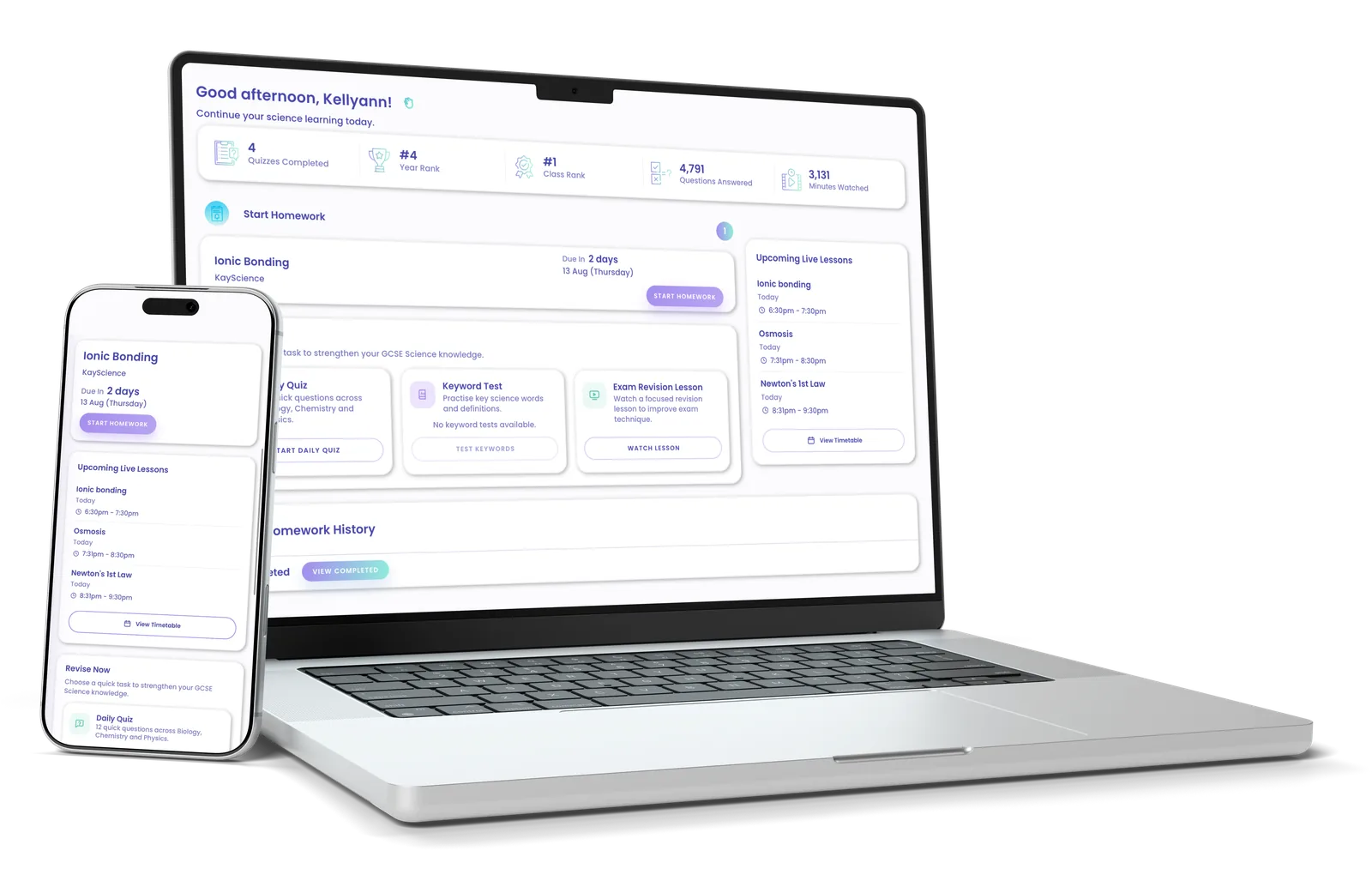
KayScience combines GCSE Science video lessons with quizzes, exam-style questions and progress information. It may suit students who need a clearer route from learning a topic to testing their knowledge and practising questions.
It is not intended to make free resources unnecessary. Students can continue using their school materials, exam-board specifications and past papers alongside the platform.
Free resources are not automatically inferior to paid platforms. The important question is whether the student can turn those resources into a consistent process of learning, retrieval, exam practice and correction.
Try KayScience Before Deciding
Parents and students can start a free KayScience trial to assess whether the additional structure suits their revision needs before choosing whether to continue.
Start revising today
800+ video lessons, quizzes and exam questions for GCSE Science.
Start Your Free Trial