
Is BBC Bitesize Enough for GCSE Science?
BBC Bitesize is useful for reviewing GCSE Science content quickly, but no single resource is automatically enough for every student. Students also need retrieval practice, calculations, required-practical questions, longer exam answers and a system for identifying and correcting weaknesses.
The answer therefore depends on how BBC Bitesize is being used. It can be a valuable part of a revision routine, particularly for reviewing unfamiliar content or refreshing knowledge before attempting questions. However, reading explanations and watching revision clips should not replace active exam practice.
Quick Verdict: Is BBC Bitesize Enough?
BBC Bitesize can be enough for a student who already understands most of the course, revises independently and uses other resources for exam questions and practical work.
For many students, however, it is better used as a starting point rather than a complete revision system.
GCSE Science exams require students to:
-
Recall information without notes
-
Apply knowledge to unfamiliar situations
-
Complete calculations accurately
-
Interpret graphs and experimental data
-
Understand required practicals
-
Write structured extended answers
-
Use precise scientific terminology
-
Learn from mark schemes and previous mistakes
A student may understand a BBC Bitesize explanation but still struggle to convert that understanding into marks.
What BBC Bitesize Does Well
BBC Bitesize has several genuine strengths.
Concise topic explanations
The explanations are generally brief and accessible. This makes the platform useful when students need to review a topic without working through a long textbook chapter.
Broad curriculum coverage
Students can access material across GCSE Biology, Chemistry and Physics. This makes it convenient for checking key ideas from different parts of the course.
Free access
BBC Bitesize is free to use, which makes it an accessible starting point for students and parents.
Familiar language
The language is usually straightforward and student-friendly. This can help students who find textbooks or specification documents difficult to understand.
Useful starting point for revision
BBC Bitesize can help a student regain basic understanding before moving on to retrieval practice and exam questions.
For example, a student who has forgotten electrolysis could first review the process using BBC Bitesize. They should then close the page, explain the process from memory and attempt questions without support.
That sequence turns passive review into active revision.
What Students Still Need to Do
Reading or watching content can create a feeling of familiarity, but familiarity is not the same as being able to answer an exam question.
Students must also complete the following work.
Answer questions without notes
Students need to retrieve information from memory rather than repeatedly rereading the same explanation.
They can do this using flashcards, quizzes, blank-page recall or short exam questions. Any incorrect or incomplete answer should be revisited later.
Practise calculations
GCSE Science includes calculations across Biology, Chemistry and Physics.
Students must practise:
-
Selecting the correct equation
-
Substituting values
-
Rearranging equations
-
Converting units
-
Showing working
-
Giving answers to an appropriate number of significant figures
Looking at worked examples is useful, but students must eventually complete calculations independently.
Use exam-board materials
Students should check which exam board they are studying and use the correct specification, past papers and mark schemes.
The exact content and assessment structure can differ between AQA, Pearson Edexcel, OCR and other exam boards.
Review required practicals
Students must understand the methods, variables, measurements, calculations and evaluations associated with their required practicals.
They should be able to answer questions about:
-
Independent, dependent and control variables
-
Equipment and methods
-
Risk reduction
-
Accuracy and reliability
-
Graphs and results
-
Sources of error
-
Improvements to an investigation
The GCSE Science Required Practicals guide explains how practical knowledge is assessed in written examinations.
Write extended answers
Students need regular practice with four-mark and six-mark questions.
A strong extended answer normally requires accurate scientific vocabulary, logical sequencing and clear links between ideas. Students should practise planning these answers before writing them.
The GCSE Science Six-Mark Questions guide explains how students can structure longer responses more effectively.
Analyse mark schemes
Mark schemes help students understand the level of precision expected by examiners.
Students should compare their answer with the mark scheme and identify:
-
Missing scientific terms
-
Incomplete explanations
-
Unnecessary information
-
Incorrect sequences
-
Failure to answer the command word
They should not simply look at the mark scheme and move on.
Correct mistakes
Mistakes are useful only when students correct them.
A revision system should record which topics, calculations and question types caused difficulty. Students should then revisit those weaknesses rather than continuing to revise topics they already find comfortable.
The GCSE Science Exam Mistakes guide covers common errors involving command words, terminology, calculations and extended responses.
BBC Bitesize and Active GCSE Science Revision
The fairest comparison is not between BBC Bitesize and every other revision platform. The more useful comparison is between passive and active revision.
| Revision need | BBC Bitesize can help with | Additional work still needed |
|---|---|---|
| Topic recap | Concise explanations | Retrieval without notes |
| Practical knowledge | Basic summaries | Detailed methods and exam questions |
| Exam technique | Some guidance | Repeated application and feedback |
| Calculations | Examples | Independent mixed practice |
| Revision planning | Content access | A consistent schedule and progress checks |
BBC Bitesize can support each part of the process, but the student must still perform the work shown in the final column.
How to Use BBC Bitesize Effectively
A student could use the following routine for each topic:
-
Read or watch a concise explanation.
-
Close the resource.
-
Write down everything remembered.
-
Check for missing or incorrect information.
-
Complete several questions without notes.
-
Mark the answers carefully.
-
Record mistakes and weak areas.
-
Return to the topic several days later.
This is more effective than moving through multiple pages without checking whether the information can be recalled.
Students should also mix topics rather than completing only one type of question at a time. For example, a revision session could include a Biology practical question, a Chemistry calculation and a Physics explanation.
Mixed practice makes it harder to rely on clues from the surrounding topic and more closely reflects the demands of an examination.
When Students May Need More Structure
Some students can organise their own revision successfully. Others repeatedly:
-
Revise only their favourite topics
-
Avoid difficult calculations
-
Skip required practicals
-
Watch videos without answering questions
-
Fail to review mistakes
-
Revise inconsistently
-
Give up when questions become difficult
These students may benefit from a more structured sequence of teaching, retrieval, quizzes and exam-question practice.
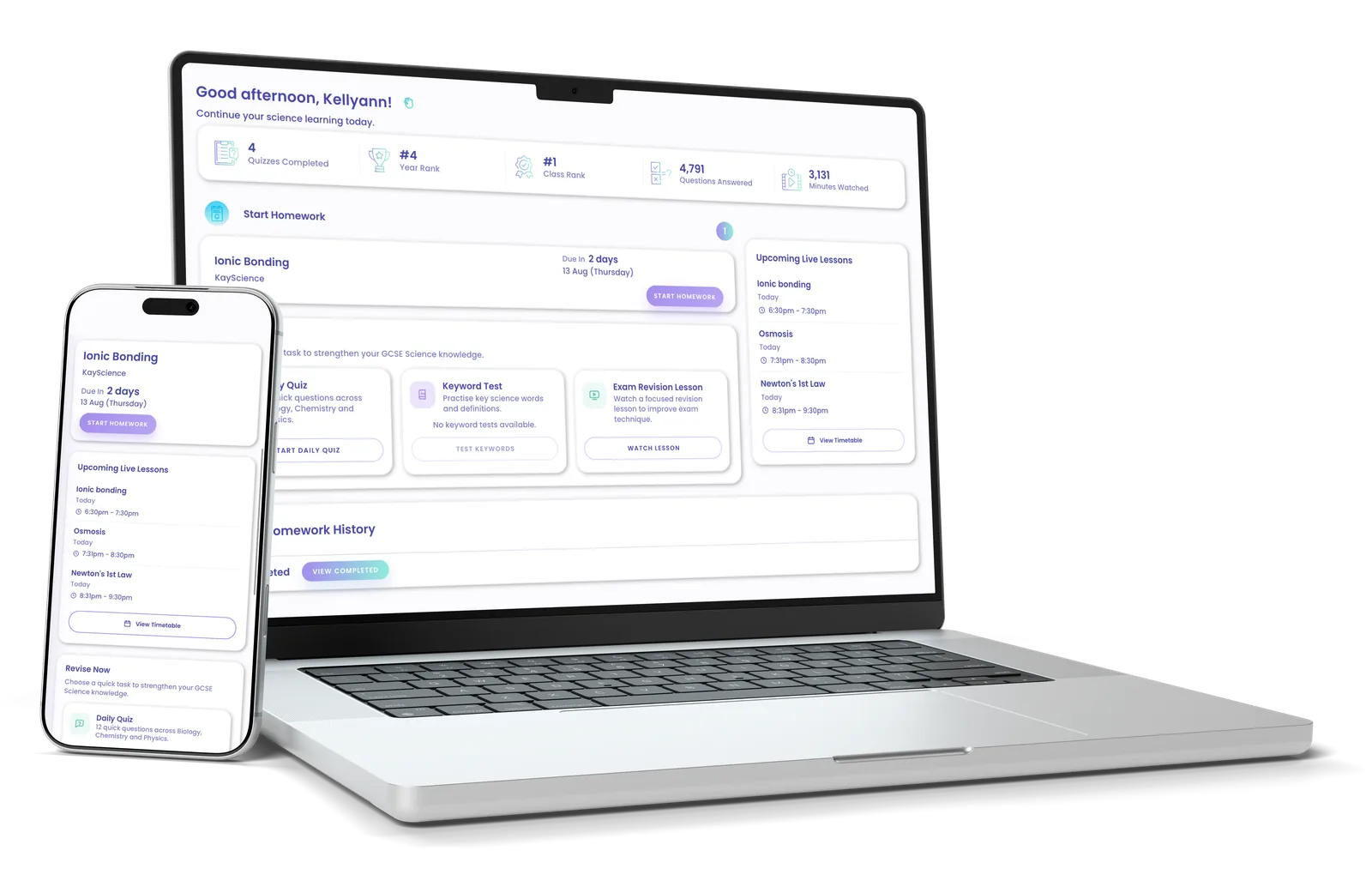
KayScience helps students work through GCSE Biology, Chemistry and Physics using video lessons, quizzes, flashcards and exam-style questions. It is designed to supplement school teaching and free revision resources rather than prevent students from using them.
The issue is not whether BBC Bitesize is “good” or “bad.” The issue is whether the student is using it as one part of an active revision process.
Start with a Free Trial
Students who need more structure can use the Free Trial to explore KayScience lessons, quizzes and exam-style practice.
The trial allows families to assess whether the platform helps the student revise more actively and consistently before committing to a subscription.
Start revising today
800+ video lessons, quizzes and exam questions for GCSE Science.
Start Your Free Trial