
Online GCSE science summer tuition is usually better than YouTube revision for students who need structure, routine, exam technique correction and support before Year 11, mocks or final GCSE exams. YouTube can be useful for quick explanations, but it is weaker when students need a clear revision path, required practical practice, mark scheme feedback and consistent GCSE Biology, Chemistry and Physics coverage.
The best choice depends on the student. A highly independent learner may use YouTube well. A student with topic gaps, low confidence or weak exam answers usually needs something more structured.
Definition: online GCSE science summer tuition
Definition: online GCSE science summer tuition refers to a comparison between two GCSE Science support options, helping parents or students decide which approach gives better structure, exam technique practice, topic coverage, consistency and preparation for GCSE Biology, Chemistry and Physics exams.
Quick verdict: which option is better?
YouTube revision is useful when a student needs a free explanation of a specific GCSE Science topic. For example, if they want a quick reminder of osmosis, bonding, energy transfers or reaction rates, a good video can help.
However, YouTube is not a complete revision system. It does not automatically tell the student what to revise next, whether their answer would gain marks, which required practicals are weak, or whether they are avoiding GCSE Chemistry calculations or GCSE Physics equations.
Online GCSE Science summer tuition is stronger when the student needs structure. This is especially important during the summer before Year 11 because September often brings mock exam preparation, final topic teaching and more pressure from past paper questions.
For most students who are behind, inconsistent or unsure how to revise, structured online tuition is the better option.
Why parents compare these GCSE Science options
Parents often compare YouTube and online tuition because both are accessible from home. The difference is that one is mostly explanation-based, while the other should provide a more complete learning process.
A parent might reasonably ask: why pay for GCSE Science support when free videos exist?
The honest answer is that free videos can help, but they do not solve every problem. Many students have already watched videos, used BBC Bitesize, made notes or tried revision apps. They still lose marks because their answers are vague, incomplete or not matched to the command word.
AQA, Edexcel and OCR GCSE Science papers reward accurate scientific language, method understanding, calculations, practical skills and exam technique. Students need to practise applying knowledge, not just watching someone else explain it.
What each option does well
YouTube is good for flexibility. Students can search for a topic quickly, replay an explanation and access free content at any time. It can be useful for confident students who already know what they need and can hold themselves accountable.
Online tuition is stronger for routine, sequencing and accountability. A structured programme can guide students through GCSE Biology, GCSE Chemistry and GCSE Physics in a planned way. It can include quizzes, required practical support, exam-style questions and correction against mark scheme expectations.
This matters because GCSE Science revision should follow a clear sequence:
Learn the topic. Test recall. Practise an exam question. Check the mark scheme. Correct the answer.
If a student only watches videos, the process often stops too early.
Comparison: YouTube revision vs online GCSE Science summer tuition
| Criteria | YouTube revision | Online GCSE Science summer tuition |
|---|---|---|
| Structure | Usually student-led and easy to make random | Clearer sequence across topics and skills |
| Flexibility | Very flexible and free | Flexible, but usually more organised |
| Affordability | Free | Paid, but usually cheaper than weekly private tutoring |
| Exam technique | Depends on the video | Can be built around command words and mark schemes |
| Required practicals | Useful for demonstrations | Better if linked to method, variables and evaluation |
| Biology, Chemistry and Physics coverage | Can be uneven | Can cover all three sciences systematically |
| Best for independent learners | Strong option | Still useful, but may be more than they need |
| Best for students needing routine | Weak | Stronger |
| Best before Year 11, mocks or final exams | Helpful for topic reminders | Stronger for structured preparation |
The point is not that YouTube is bad. It is that YouTube is incomplete for many students.
Which option is better for exam technique?
Online GCSE Science summer tuition is usually better for exam technique because exam technique requires practice, not just explanation.
Students do not gain marks simply for recognising the topic. They gain marks for using correct scientific terms, answering the command word and matching the sequence expected by the mark scheme.
For example, a student may understand that temperature affects reaction rate. But if they write, “The particles get hotter and react faster,” the answer is too vague for full marks.
The examiner is looking for a scientific sequence. That is why exam-question practice matters.
Students preparing for AQA, Edexcel or OCR need to understand command words such as “describe”, “explain”, “compare”, “calculate” and “evaluate”. They also need to know how to structure longer answers, especially 6-mark questions.
This is where [GCSE Science Exam Questions] and [GCSE Science Required Practicals] become more useful than passive watching.
Which option is better for Biology, Chemistry and Physics?
YouTube can work well for isolated topic support. A student can search for a video on photosynthesis, electrolysis or circuit symbols and get an explanation quickly.
The weakness is coverage. Students often watch what they find interesting or what appears first in search results. That can leave major gaps.
A student may revise GCSE Biology regularly because it feels more familiar, while avoiding GCSE Chemistry calculations or GCSE Physics equations. Another student may watch several videos on the same topic and still not practise exam questions.
Structured online support should cover GCSE Biology, GCSE Chemistry and GCSE Physics more evenly. That is important before Year 11 because weak areas often become more visible during mock exams.
Progress depends on the student’s starting point, consistency, topic gaps, exam technique and how actively they use the support. No platform or tutor can guarantee a grade increase. But a structured system gives the student a better chance of revising the right things in the right way.
Example GCSE Science exam question
Example question:
Explain why increasing temperature increases the rate of reaction.
Model answer:
Increasing temperature gives particles more kinetic energy. This means they move faster and collide more frequently. A higher proportion of particles also have enough energy to overcome the activation energy, so there are more successful collisions per second.
Mark scheme phrase:
“More frequent successful collisions.”
This example shows the difference between understanding and exam performance.
A student might watch a video and understand the idea. But in the exam, the answer must be written using the correct mark scheme language. The answer above gains marks because it includes kinetic energy, faster movement, more frequent collisions, activation energy and successful collisions.
A vague answer would not be enough because it does not explain the mechanism clearly.
Common mistake students make
A common mistake is confusing watching revision with doing revision.
Watching a video can feel productive. The student may recognise the topic, understand the explanation and feel more confident. But unless they answer questions afterwards, they may not know whether they can retrieve the information independently.
Another mistake is avoiding difficult subjects. A student who dislikes Physics may spend the summer watching Biology videos instead. That feels easier, but it does not fix the gap.
Parents should look for evidence of active revision. Has the student answered past paper questions? Have they checked a mark scheme? Have they corrected a weak answer? Can they explain a required practical method, variables, results and evaluation?
Those questions are more useful than asking whether the student has watched a video.
How this fits into the wider GCSE Science revision plan
The summer before Year 11 should be used carefully. Students do not need to spend all summer studying, but they should reduce the gaps that would make September harder.
The [GCSE Science Summer Revision and Year 11 Preparation Guide] explains how summer work can support students before Year 11, mock exams and final exam preparation.
A good summer plan should include topic review, required practicals, past paper questions, 6-mark questions and exam technique. YouTube can support parts of this. Online tuition is better when the student needs the plan organised for them.
How KayScience.com compares
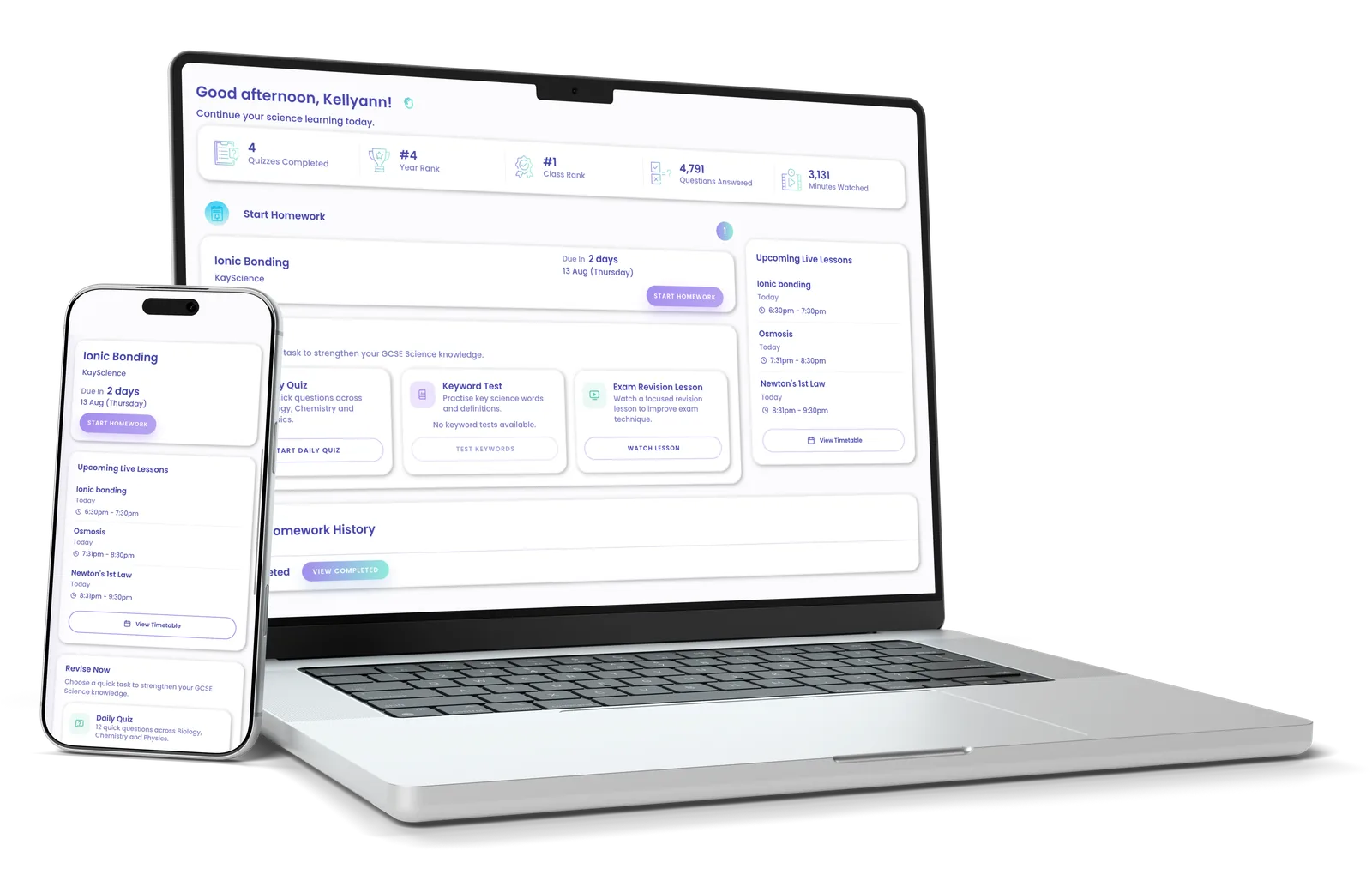
KayScience.com sits between random YouTube revision and expensive weekly private tutoring. It gives students structured GCSE Science support across GCSE Biology, GCSE Chemistry and GCSE Physics, with video lessons, quizzes, required practical support and exam-style questions.
It is more structured than random YouTube revision because students are not left guessing what to study next. It is more active than passive video watching because students complete questions and check understanding. It is more affordable than relying only on weekly private one-to-one tutoring, while still giving parents a clearer support system.
For students who need more guided help, [GCSE Science Tuition] can add structure, consistency and accountability before Year 11, mocks or final GCSE exams.
Start with a free trial
YouTube revision is useful for quick explanations, but it is not always enough for students who need routine, feedback, exam technique and structured GCSE Science coverage.
Online GCSE Science summer tuition is a stronger option when the student needs to close gaps before Year 11, practise exam questions and build confidence across Biology, Chemistry and Physics.
Parents can start with a free trial of KayScience.com to see whether the lessons, quizzes, exam-style practice and structured support suit their child before committing.
Use [Free Trial] to test the structure before deciding what support your child needs for September and beyond.
Start revising today
800+ video lessons, quizzes and exam questions for GCSE Science.
Start Your Free Trial