
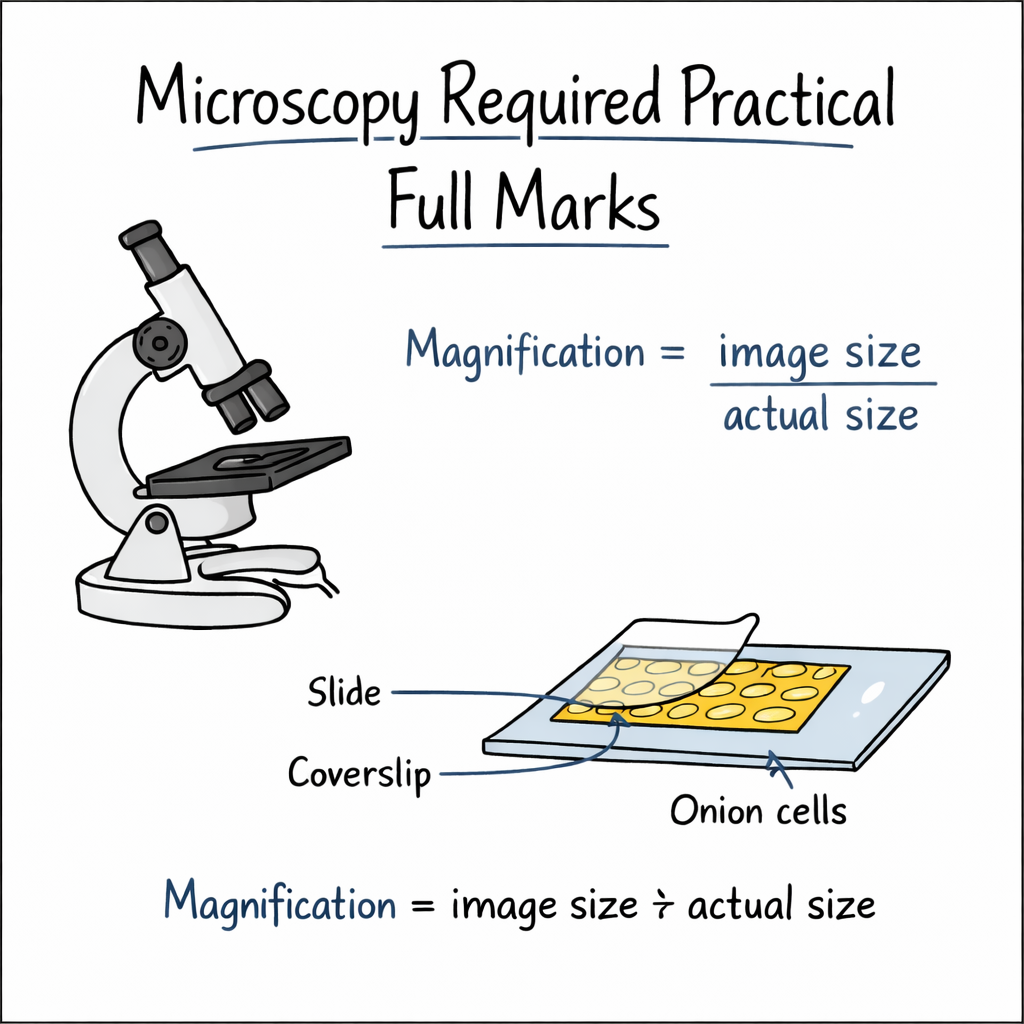
Microscopy Required Practical GCSE: How to Secure Full Marks
Why Year 10 Students Should Master Microscopy Before Year 11
The microscopy required practical in GCSE Biology tests whether students can prepare a slide, use a microscope correctly, calculate magnification and explain how to improve the image. To secure full marks, students need to know the method, variables, observations and common exam mistakes.
How to Prepare a Slide Correctly (Method Marks)
For a standard light microscopy practical, you may be asked to prepare a slide of onion epidermis or cheek cells.
A full-mark method answer should include:
-
Place a thin layer of cells onto a clean glass slide.
-
Add a drop of stain (iodine for plant cells, methylene blue for animal cells).
-
Carefully lower a coverslip at an angle using a mounted needle to avoid air bubbles.
-
Remove excess stain with tissue.
-
Start with the lowest magnification before increasing.
Examiners expect the reason for staining: to make cell structures more visible. Simply saying “add stain” without explaining why can limit marks.
For structured revision across required practicals, see KayScience.com.
Calculating Magnification (Where Students Lose Marks)
The required formula is:
Magnification = image size ÷ actual size
You must convert units into the same form before calculating.
Example Calculation
A cell measures 40 mm on a printed image.
The actual cell size is 20 µm.
First convert 40 mm into micrometres:
40 mm = 40,000 µm
Now calculate:
Magnification = 40,000 ÷ 20
Magnification = 2000×
Common error: forgetting unit conversion. This alone costs one mark immediately.
Practise similar calculation questions in Exam Questions.
Microscopy full marks checklist
-
- Prepare a thin specimen
- Add a stain if needed
- Place the cover slip carefully
- Start on low power
- Focus using the coarse then fine focus
- Calculate magnification correctly
- Describe how to improve image clarity
What Examiners Commonly Penalise
Across AQA, Edexcel and OCR mark schemes, typical mistakes include:
-
Writing “zoom” instead of “magnification”
-
Forgetting to mention starting on low power
-
Not explaining why a coverslip is lowered at an angle
-
Incorrect unit conversion (mm to µm)
-
Missing multiplication symbol (×) after the magnification value
Precision matters. Scientific vocabulary is assessed.
Example question:
Describe how a student should prepare a slide of onion cells to view under a light microscope.
Mark scheme:
-
- Cut a thin section
- Place on slide
- Add iodine stain
- Lower cover slip carefully
- Use low power objective first
- Focus using the fine adjustment
Exam Technique Tip
When describing the microscopy required practical, write in clear sequential steps and include at least one reason for a step (e.g., stain improves visibility, angle prevents air bubbles). This pushes answers into higher mark bands.
For targeted support with exam-style practical questions, visit https://kayscience.com/tuition-timetable.
Start a free KayScience trial now
If your child struggles with required practical questions, KayScience helps students revise GCSE Biology, Chemistry and Physics using video lessons, quizzes, exam-style questions and live online tuition.
Start revising today
800+ video lessons, quizzes and exam questions for GCSE Science.
Start Your Free Trial