
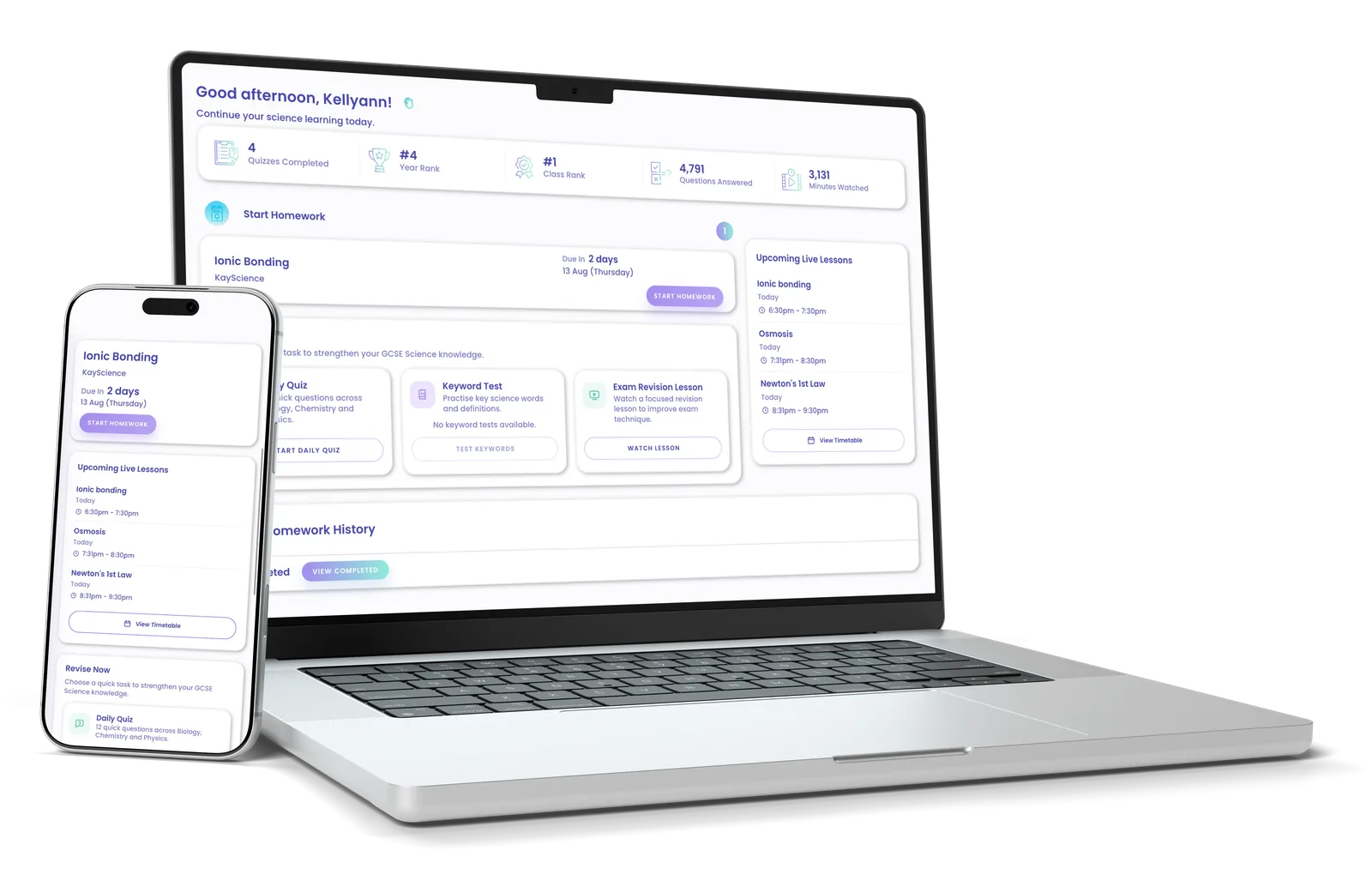
An online GCSE science course should not replace good school teaching, but it can give students extra structure, exam practice and revision support outside the classroom. School lessons are essential for covering the specification, practical work and teacher feedback, while KayScience.com can help students revisit topics, practise past paper questions and improve exam technique at home.
For many parents, the real question is not whether online learning is better than school. It is whether their child needs a more organised way to revise GCSE Biology, GCSE Chemistry and GCSE Physics between school lessons, before mock exams and in the run-up to final GCSE exams.
Quick verdict: which option is better?
School teaching is the foundation. Students need classroom lessons, teacher explanations, required practicals, assessment feedback and the structure of their school timetable.
An online GCSE science course is better seen as support around school, not a replacement for it. It helps students revise topics again, fill gaps, practise exam-style questions and build confidence when they are not in the classroom.
KayScience.com is useful because it gives students a structured revision system across GCSE Biology, GCSE Chemistry and GCSE Physics. Instead of relying on random YouTube videos or last-minute revision, students can use lessons, quizzes, flashcards, live tuition and exam-style practice in one place.
The balanced verdict is simple:
School teaching is best for delivering the main GCSE Science course.
KayScience is best for structured revision, repeated practice and exam technique outside school.
Why parents compare school teaching with online GCSE Science support
Parents usually compare these options when their child is working hard at school but still not performing as expected in mock exams.
This can happen for several reasons. The student may understand topics during lessons but forget them later. They may know the content but struggle to write answers in the language expected by the mark scheme. They may avoid weak areas because they do not know where to start. They may also revise passively by watching videos without testing themselves.
School teachers have limited lesson time. They need to teach whole classes, cover the specification, prepare students for assessments and manage different ability levels. Even excellent teachers cannot sit with every student every evening and guide their independent revision.
That is where structured online support can help. It gives students a routine outside school and helps parents feel that revision is not being left to chance.
Online GCSE science course
Definition: online GCSE science course refers to a comparison between two GCSE Science support options, helping parents or students decide which approach gives better structure, exam technique practice, topic coverage, consistency and preparation for GCSE Biology, Chemistry and Physics exams.
A good online course should not simply provide videos. It should help students learn, check understanding, practise exam questions and review mistakes. This matters because GCSE Science success depends on both knowledge and application.
For AQA, Edexcel and OCR, students need to handle command words, required practicals, calculations, graphs, extended responses and scientific vocabulary. They also need to understand how examiners award marks.
KayScience.com is built around that need. It supports students with GCSE Biology, GCSE Chemistry and GCSE Physics in a way that can sit alongside school teaching.
What school teaching does well
School teaching is essential. It gives students direct contact with qualified teachers, classroom discussion, practical demonstrations, required practical experience and formal assessment.
A good school science department will:
• Teach the GCSE specification in sequence
• Set classwork and homework
• Prepare students for mock exams
• Cover required practicals
• Give feedback on assessments
• Support students with exam-board content for AQA, Edexcel or OCR
School also gives students routine. They attend lessons each week, complete tasks and receive teacher direction.
This is why parents should not view an online course as a substitute for school. The better question is whether the student is doing enough effective work outside lessons to secure the content and improve exam performance.
Where school teaching can fall short
The weakness is usually not the teacher. It is the limits of time.
In a class of students with different abilities, a teacher has to move through the course at a realistic pace. Some students need more repetition than the timetable allows. Others need more exam practice than can be fitted into lessons. Some understand the topic in class but forget it two weeks later.
There is also a gap between teaching and independent revision. Many students are told to revise, but they do not know how to revise effectively.
They may spend time making notes, highlighting pages or watching videos, but avoid past paper questions because they are harder. This creates a false sense of progress.
A classroom teacher or examiner would say: the student has not truly revised a topic until they can answer an exam-style question on it without help.
KayScience vs school teaching: clear comparison
| Area | School teaching | KayScience.com |
|---|---|---|
| Best for core teaching | Stronger | Supports and reinforces school learning |
| Best for required practicals | Stronger in classroom context | Helps revise practical methods and exam questions |
| Best for repeated revision | Limited by timetable | Stronger for revisiting topics at home |
| Best for exam technique | Depends on lesson time | Built around exam-style practice |
| Best for flexibility | Fixed timetable | Available outside school hours |
| Best for Biology, Chemistry and Physics support | Covered by school course | Covered in one structured online system |
| Best for affordability | Included through school | More affordable than weekly private tutoring |
| Best before mocks | Provides assessments | Helps students prepare and close gaps |
This is not a case of school versus KayScience. The strongest approach is school plus structured support at home.
Which option is better for exam technique?
KayScience is particularly useful for exam technique because students can practise applying knowledge after school lessons.
GCSE Science marks are not awarded just for recognising a topic. Students gain marks for using the correct scientific terms, answering the command word and matching the sequence expected by the mark scheme.
For example, if a question says “explain”, a student usually needs linked reasoning. If it says “describe”, they may need observations or a process. If it says “compare”, they need similarities or differences.
Many students lose marks because their answer is too vague. They may understand the science but fail to include the key phrase the examiner is looking for.
A realistic mark scheme phrase might be: “more frequent successful collisions.”
That phrase is precise. It is much stronger than “particles move more.”
Which option is better for Biology, Chemistry and Physics?
School teaching covers the full GCSE Science course, but students often need more time to revisit weaker areas.
KayScience helps because students can revise across GCSE Biology, GCSE Chemistry and GCSE Physics in one place. This is useful when weaknesses are uneven.
A student may be strong in Biology but struggle with Chemistry calculations. Another may understand Chemistry but lose marks in Physics electricity questions. Another may know content but struggle with required practicals across all three sciences.
For students aiming for Grade 4 to 5, the priority is often securing core knowledge and writing clearer answers. For students aiming for Grade 7 to 9, the priority is often applying ideas to unfamiliar questions and improving precision.
Both types of student can benefit from structured revision, but the way they use it may be different.
Example GCSE Science exam question
Example question:
Explain why increasing temperature increases the rate of reaction.
Model answer:
Increasing temperature gives particles more kinetic energy. This means they move faster and collide more frequently. A higher proportion of particles also have enough energy to overcome the activation energy, so there are more successful collisions per second.
Mark scheme phrase:
“More frequent successful collisions.”
This example shows why exam practice matters. A student may know that temperature affects rate of reaction, but the marks come from explaining kinetic energy, collision frequency, activation energy and successful collisions.
Common mistake students make
A common mistake is thinking that watching a video means they have revised.
Watching a video can help with understanding, but it is not enough. Students need to test themselves, answer questions, mark their work and correct mistakes.
This is where an online GCSE Science course needs to be more than a video library. If the student only watches passively, they may feel more confident without actually being more exam-ready.
KayScience is designed to make revision more active by combining explanations with quizzes, flashcards, live tuition and exam-style practice.
How KayScience.com compares
KayScience.com works best as a structured support layer alongside school teaching.
It does not replace the school science teacher. It helps students revisit content, build a weekly revision habit and practise the types of questions that appear in GCSE exams.
For busy families, this can be more practical than arranging weekly private tutoring. It is also more structured than asking a child to “go and revise science” without giving them a clear system.
Progress depends on consistency, starting point, topic gaps, exam technique and how actively the student uses the support. KayScience does not guarantee grade improvement, and no credible course should. But it can give students a clearer, more organised way to prepare for mocks and final GCSE exams.
Start with a free trial
Parents should choose school teaching as the foundation and use KayScience.com when their child needs more structure, revision routine and exam-question practice outside school.
Parents can start with a free trial of KayScience.com to see whether the structure, lessons, quizzes and exam-style practice suit their child before committing.
Start revising today
800+ video lessons, quizzes and exam questions for GCSE Science.
Start Your Free Trial