
How often revise GCSE science?
Parents often ask how often revise GCSE science because they want a clear routine without overwhelming their child. A sensible GCSE Science revision pattern is usually little and often: short, focused sessions across Biology, Chemistry and Physics each week, combined with regular exam-question practice and review of weak areas.
For most students, GCSE Science revision should not be left until mocks or the final few months. The better approach is consistent weekly revision, where students revisit key topics, practise past paper questions, improve exam technique and correct mistakes before they become habits.
This article is for parents deciding how best to support their child with GCSE Science, especially if revision currently feels random, inconsistent or too dependent on YouTube videos and last-minute cramming.
Why parents ask how often revise GCSE science
Parents usually ask this question when they can see their child working, but are not sure whether that work is effective. A student might spend time watching videos, highlighting notes or making flashcards, but still struggle to improve their mock exam marks.
The real issue is not always the number of hours. It is the quality and consistency of revision.
GCSE Science covers a large amount of content across GCSE Biology, GCSE Chemistry and GCSE Physics. Students need to remember facts, understand processes, apply equations, interpret graphs, describe required practicals and answer questions using the wording expected by the mark scheme.
That means revision needs to be regular enough to build memory, but structured enough to improve exam performance.
A good starting point for many students is:
• Year 10: 2 to 3 focused GCSE Science revision sessions per week
• Year 11 before mocks: 3 to 4 focused sessions per week
• Year 11 before final exams: shorter daily revision, with more past paper questions
This will vary depending on the student’s target grade, current confidence, exam board and topic gaps. A student aiming for Grade 4 or 5 may need help securing core knowledge and exam technique. A student aiming for Grade 7 to 9 may need more practice with application, extended answers and higher demand questions.
Definition: how often revise GCSE science
Definition: how often revise GCSE science refers to a parent decision about GCSE Science support, including how regularly a student should revise Biology, Chemistry and Physics, how much exam-question practice they need, and whether they need a structured way to prepare for GCSE Science mocks and final exams.
What good GCSE Science revision should include
Good GCSE Science revision is not just rereading notes. It should include four things.
First, students need clear topic coverage. They should revise Biology, Chemistry and Physics across their exam board, whether they are studying AQA, Edexcel or OCR. This includes required practicals, key equations, science vocabulary and common exam contexts.
Second, they need active recall. This means testing themselves, not just looking over information. Quizzes, flashcards and short written answers help students check what they can actually remember.
Third, they need past paper questions. GCSE Science marks are awarded for precise scientific language, not general understanding. Students should practise questions regularly so they learn how mark schemes work.
Fourth, they need feedback. This may come from a teacher, tutor, structured platform or self-marking system. Without feedback, students can repeat the same mistakes for months.
An examiner-level insight is this: students do not gain marks simply because they “know the topic”. They gain marks when they use the correct scientific terms in the correct sequence and match the command word in the question.
As a classroom teacher or examiner would say: a student can understand the science in their head but still lose marks if the answer is too vague on paper.
How KayScience.com supports GCSE Science revision
KayScience.com helps make GCSE Science revision more structured by giving students a clear system rather than leaving them to decide what to revise alone.
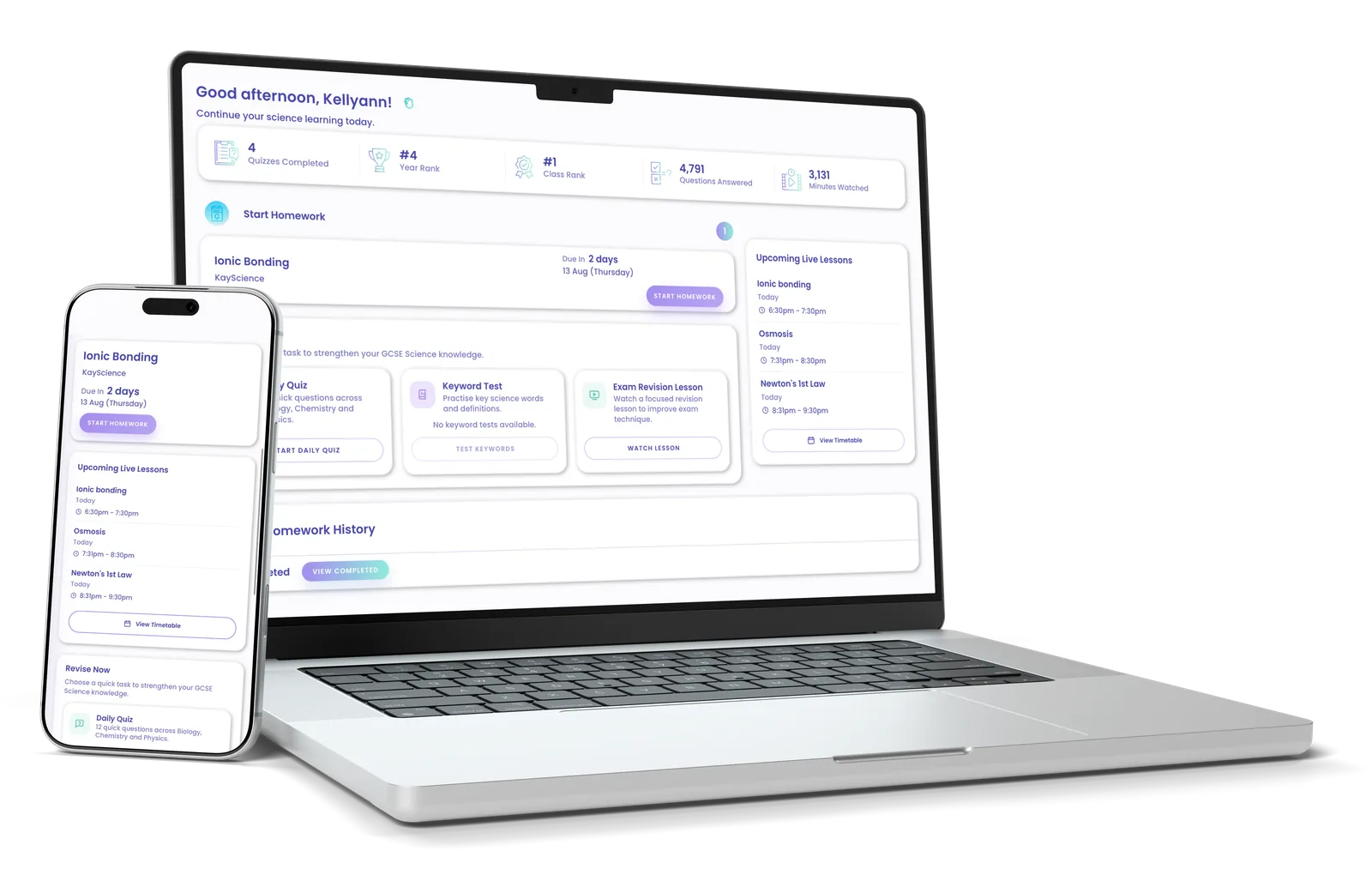
Students can use KayScience for GCSE Biology, GCSE Chemistry and GCSE Physics, with video lessons, quizzes, flashcards, exam practice and live tuition support. This is useful for parents who want their child to revise consistently without needing to organise a private tutor every week.
The key benefit is structure. Instead of a student randomly searching YouTube, watching half a video and then moving on, KayScience encourages a more active process:
Watch the lesson.
Check understanding.
Complete questions.
Practise exam-style answers.
Review weak areas.
That matters because GCSE Science improvement depends on repeated exposure, active recall and exam technique, not one-off revision sessions.
KayScience is also more affordable than weekly private one-to-one tutoring for many families. A private tutor may be useful for highly personalised support, but it can become expensive and availability can be limited. KayScience gives students regular access to GCSE Science learning and revision support in a more scalable way.
How often should students revise before mocks and exams?
Before mock exams, students should revise early enough to identify weak topics. Leaving revision until the week before a mock usually means students only cover familiar topics and avoid the ones they find difficult.
A better routine is:
In Year 10, students should revise little and often after each topic. This helps prevent knowledge from being forgotten.
In early Year 11, students should revise several times per week and start using past paper questions more frequently.
In the final months before exams, students should complete regular exam-style practice across Biology, Chemistry and Physics. At this stage, revision should be more targeted. Students should know which topics are weak, which required practicals they cannot explain and which question types cost them marks.
Parents should not judge revision by time alone. One focused 30-minute session with exam questions and corrections is usually better than two hours of passive video watching.
Example GCSE Science exam question
Example question:
Explain why increasing temperature increases the rate of reaction.
Model answer:
Increasing temperature gives particles more kinetic energy. This means they move faster and collide more frequently. A higher proportion of particles also have enough energy to overcome the activation energy, so there are more successful collisions per second.
Mark scheme phrase:
“More frequent successful collisions.”
This is a good example because many students understand the basic idea but fail to include enough precise scientific detail.
Common mistake students make
A common mistake is writing vague answers such as “the particles move more” or “the reaction gets faster” without explaining collision frequency, activation energy or successful collisions.
This is why exam technique matters. The mark scheme is not rewarding effort or general knowledge. It is rewarding specific points.
Students also make the mistake of revising what feels comfortable. They may spend time on topics they already know because it feels productive, while avoiding harder areas such as electricity, quantitative chemistry, inheritance, rates of reaction or required practicals.
Structured revision helps because it forces students to cover the full course rather than only revising their favourite topics.
Is online GCSE Science revision enough?
Online GCSE Science revision can work well when it is structured and active. It is less effective when students only watch videos passively.
This is where parents need to be careful. Free YouTube videos can be useful for quick explanations, but they rarely provide a complete revision system. Students still need quizzes, exam practice, topic tracking, required practical revision and mark scheme awareness.
Group tuition can also be useful when it follows a clear GCSE structure. It may not be as individually tailored as one-to-one tutoring, but it can offer consistency, affordability and regular exposure to exam technique.
For many students, the best support is not necessarily the most expensive option. It is the option they will actually use every week.
How parents can decide the right next step
Parents should look at three things.
First, is your child revising consistently? If revision only happens before a test, the routine is probably too weak.
Second, is your child practising exam questions? If they are only watching videos or making notes, they may not be developing the skills needed for AQA, Edexcel or OCR exam papers.
Third, does your child know what to improve? If they cannot name their weakest topics or explain why they lost marks in a mock exam, they need more structure.
Progress depends on the student’s starting point, consistency, topic gaps, exam technique and how actively they use the support. No platform or tutor can guarantee grade improvement, but a structured routine gives students a much better chance than last-minute revision.
Start with a free trial
If your child’s GCSE Science revision feels inconsistent, passive or stressful, it may be time to put a clearer system in place.
Parents can start with a free trial of KayScience.com to see whether the structure, lessons, quizzes and exam-style practice suit their child before committing.
Start revising today
800+ video lessons, quizzes and exam questions for GCSE Science.
Start Your Free Trial