
GCSE Science Tuition vs Revision Books
GCSE Science tuition and revision books solve different problems. Revision books provide affordable summaries and questions, while tuition can provide explanation, feedback and accountability. The better option depends on the student’s knowledge, independence, budget and ability to correct mistakes.
Neither option is automatically better. A well-chosen revision book may be enough for an organised student who understands most topics and can manage their own practice. Tuition may be more useful when a student has persistent gaps, needs individual explanations or struggles to revise consistently.
What Revision Books Do Well
GCSE Science revision books offer a relatively affordable way to review Biology, Chemistry and Physics. Most involve a one-off cost and can be used throughout the course without an ongoing subscription or weekly tuition fee.
A good revision book can provide:
- Concise summaries of key scientific ideas
- Worked examples for calculations and unfamiliar question types
- Practice questions at the end of topics
- Definitions and key terminology
- Coverage of required practicals
- Offline access without a device or internet connection
Revision books are particularly suitable for students who work independently. They allow students to choose when and where they revise, move quickly through familiar material and spend longer on weaker topics.
However, students must choose the correct book. It should match their:
- Exam board, such as AQA, Pearson Edexcel or OCR
- Qualification, including Combined Science or separate sciences
- Foundation or Higher tier, where applicable
- Current specification
Using a book written for the wrong course can introduce unnecessary content or leave gaps in what the student is expected to know.
Revision books are most effective when students do more than read them. After reviewing a section, the student should close the book, retrieve the key information from memory and attempt questions without looking at the answers.
Where Revision Books Are Limited
Revision books depend on the student managing much of the revision process themselves. This is not a problem for every student, but it can create difficulties when the student is unsure what they have misunderstood.
A book cannot respond to an individual misconception or explain the same concept in a different way. The written explanation may be accurate, but it may not address the precise reason the student is confused.
Self-marking can also be unreliable. Some students award themselves marks for answers that are too vague or incomplete. Others check the answer before making a serious attempt, which reduces the value of the question.
Students may also:
- Avoid calculations or longer written questions
- Spend too much time on topics they already enjoy
- Read explanations without testing their recall
- Move on without correcting mistakes
- Struggle to create and follow a revision timetable
These limitations do not mean that revision books are ineffective. They mean the student must provide the organisation, honesty and discipline that the book cannot provide.
Our guide to GCSE Science exam mistakes explains how students can lose marks through vague wording, incomplete calculations and poor interpretation of questions even when they know some of the underlying science.
GCSE Science Tuition vs Revision Books
| Factor | Revision book | Tuition |
|---|---|---|
| Cost | Usually an affordable one-off purchase | Usually involves a higher ongoing cost |
| Flexibility | Can be used at any time and at the student’s own pace | Usually follows scheduled sessions, although online options may be more flexible |
| Personalised explanation | Provides fixed written explanations and worked examples | A tutor can adapt explanations and respond to questions |
| Feedback | Usually relies on answers, mark schemes and honest self-marking | Can provide direct feedback on knowledge, calculations and written answers |
| Accountability | Depends mainly on the student’s own routine | Scheduled work and questioning can provide greater accountability |
| Best suited to | Independent students who can organise and assess their own revision | Students who need clarification, feedback, routine or more individual support |
The quality of either option matters. A revision book that matches the specification and contains useful practice may be more valuable than unfocused tuition. Equally, a skilled tutor who diagnoses misconceptions and gives precise feedback may solve problems that a book cannot address.
When Tuition May Be More Useful
Tuition may be worth considering when a student has a specific problem that independent revision has not resolved.
This may include students who:
- Have persistent knowledge gaps across several topics
- Need scientific concepts explained in a different way
- Struggle to apply knowledge to unfamiliar questions
- Need feedback on written explanations or six-mark answers
- Regularly make mistakes when using equations or units
- Find it difficult to work independently
- Avoid topics they find challenging
- Need a consistent revision routine
Good tuition should begin by identifying what the student actually finds difficult. It should not simply repeat a standard lesson or work through a revision guide from beginning to end.
For example, a student struggling with rates of reaction may not need the whole topic retaught. They may understand that reactions become faster at higher temperatures but fail to explain the change using kinetic energy, collision frequency, activation energy and successful collisions.
A tutor can question the student, locate the missing connection and then check whether they can apply the improved explanation to a new question.
Before committing to tuition, parents should examine the student’s recent tests, school feedback and revision habits. Our guide on whether your child needs GCSE Science tuition provides a more detailed set of signs to consider.
Online or In-Person Tuition?
The effectiveness of tuition does not depend only on whether it happens online or in the same room. Tutor quality, subject knowledge, exam-board understanding, lesson structure and student engagement are more important than location alone.
In-person tuition may suit students who respond better to face-to-face interaction or need close supervision. Online tuition may offer greater flexibility, eliminate travel and give families access to tutors outside their local area.
Parents comparing these formats can read our guide to online versus in-person GCSE Science tuition.
Can Students Use Both?
Revision books and tuition can work together because they perform different roles.
A tutor might use a lesson to diagnose a misconception, question the student and model how to approach an exam question. The student can then use a revision book between lessons to review the topic, complete further practice and retrieve the knowledge independently.
However, tuition should add something that the book cannot provide. A tuition session should involve:
- Targeted questioning
- Clarification of misunderstandings
- Application to new questions
- Feedback on answers
- Decisions about what the student should practise next
Simply reading through the same pages together is unlikely to justify the additional cost.
Students should also avoid collecting too many resources. One suitable revision book, official exam-board materials and focused support are usually more manageable than switching constantly between several books, websites and tutors.
How KayScience Can Support Structured Revision
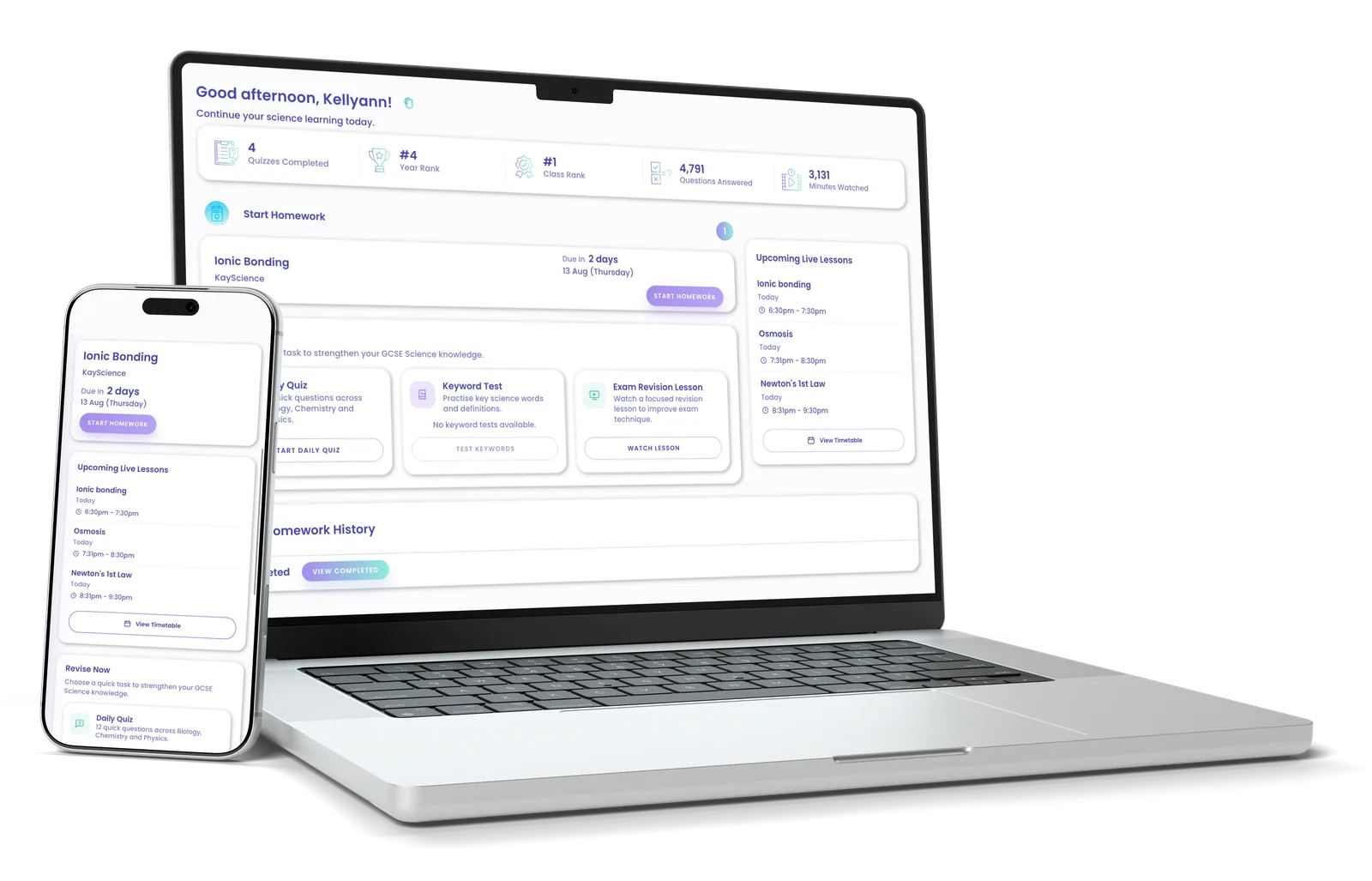
KayScience combines GCSE Science explanations with quizzes, exam-style practice and structured online support. It may suit students who need a clearer route through Biology, Chemistry and Physics but do not require traditional one-to-one tuition for every topic. It can also be used alongside revision books, school materials and official past papers.
The decision should be based on the student’s actual difficulty, not the assumption that the most expensive option must be the most effective.
Try the Support Before Committing
Parents and students can start a free KayScience trial to assess whether its lessons, questions and revision structure suit the student before deciding whether to continue.
Start revising today
800+ video lessons, quizzes and exam questions for GCSE Science.
Start Your Free Trial