
GCSE science summer catch up: Online Tuition vs Independent Revision
A GCSE science summer catch up can work through either online tuition or independent revision, but the better option depends on the student. Independent revision suits disciplined students who already know their weak areas, while structured online tuition is usually stronger for students who need routine, exam technique, required practical support and consistent practice before Year 11.
For many UK families, summer is the point where the question becomes practical: should a student revise alone using notes, YouTube, apps and past papers, or use an online GCSE Science platform such as KayScience.com? The answer is not that one option is always better. The right choice depends on confidence, gaps in GCSE Biology, GCSE Chemistry and GCSE Physics, and how well the student can turn revision into marks.
Quick verdict: which option is better?
Independent revision is useful when a student is motivated, organised and already understands what AQA, Edexcel or OCR examiners expect. It can be low cost and flexible, especially for students who only need light recap before Year 11.
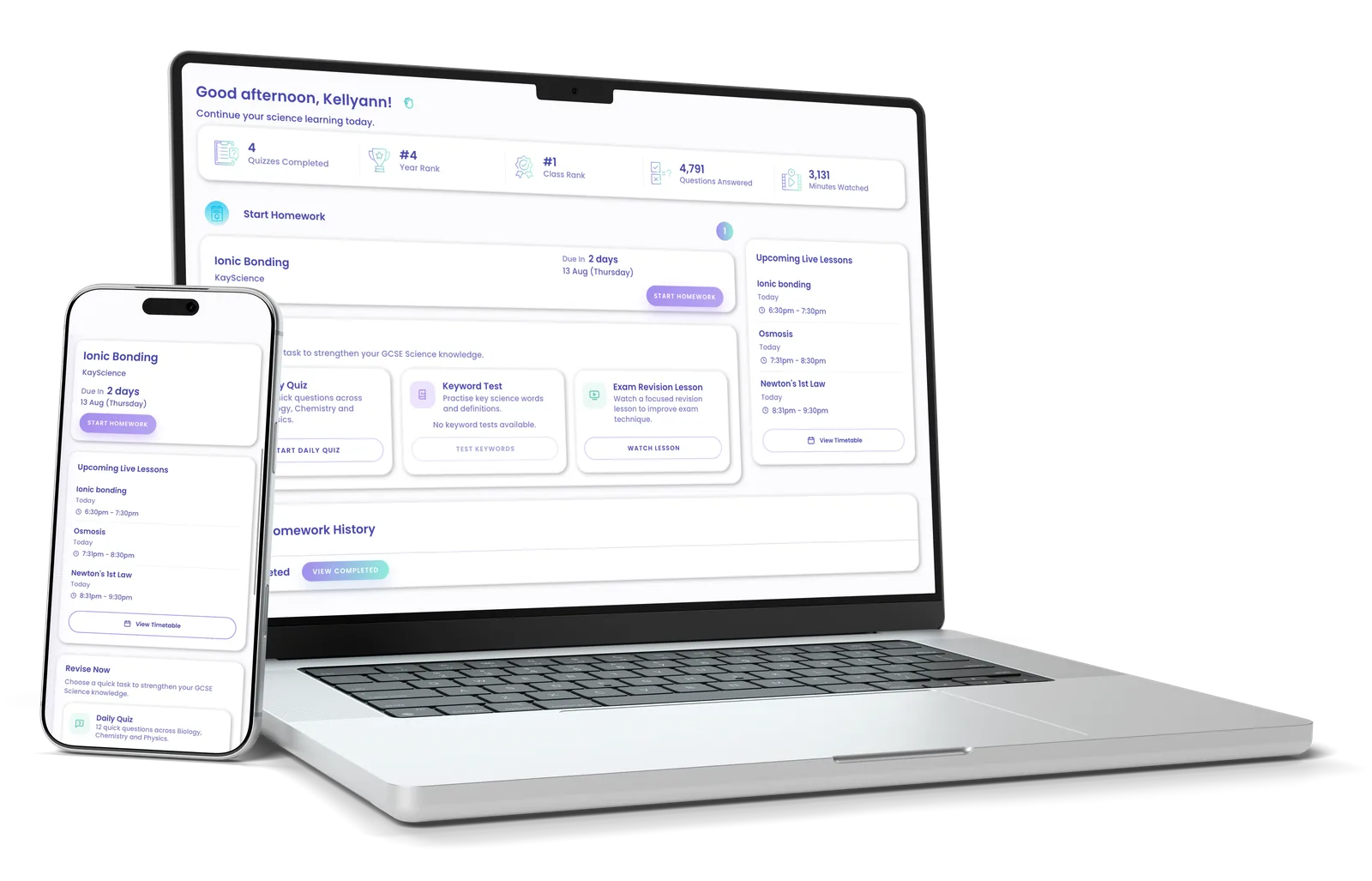
Online tuition is usually better when a student needs structure, accountability and help applying knowledge to exam questions. This is where KayScience.com is designed to sit: more structured than passive video watching, more exam-focused than many revision apps, and more affordable than regular one-to-one private tutoring.
The strongest approach for many students is not online tuition or independent revision in isolation. It is structured teaching, followed by independent exam-question practice.
Why parents compare these GCSE Science options
Parents often compare GCSE Science support options during the summer because Year 10 gaps become more serious once Year 11 begins. Mock exams, required practicals, paper structure, 6-mark questions and mark scheme wording all become more important.
A student may understand a topic in class but still lose marks because they cannot explain it clearly under exam conditions. Another student may watch several revision videos but never complete enough past paper questions to check whether they can actually score marks.
That is why the real comparison is not just “tuition or no tuition”. It is structure versus independence, guidance versus self-management, and passive revision versus active exam practice.
GCSE science summer catch up
Definition: GCSE science summer catch up refers to a comparison between two GCSE Science support options, helping parents or students decide which approach gives better structure, exam technique practice, topic coverage, consistency and preparation for GCSE Biology, GCSE Chemistry and GCSE Physics exams.
A summer catch-up should not mean trying to relearn the whole course randomly. It should identify weak topics, rebuild core knowledge, practise required practicals, improve exam technique and prepare for Year 11 mock exams.
For GCSE Biology, this might include cell biology, organisation, infection and response, bioenergetics or ecology. For GCSE Chemistry, it may include atomic structure, bonding, quantitative chemistry, chemical changes and energy changes. For GCSE Physics, it may include energy, electricity, forces, waves, magnetism or required practical methods.
Online tuition vs independent revision: comparison table
| Criteria | Independent revision | Online tuition with KayScience.com |
|---|---|---|
| Structure | Flexible, but easy to become inconsistent | Clearer routine through lessons, quizzes and exam-style practice |
| Flexibility | Very flexible and low pressure | Flexible online access with more guided learning |
| Affordability | Usually cheapest if using free resources | More affordable than regular one-to-one tutoring |
| Exam technique | Depends on student knowing how to mark answers | Stronger support for mark scheme wording and structured answers |
| Required practicals | Can be difficult without guidance | Better for method, variables, results, conclusions and evaluation |
| Biology, Chemistry and Physics coverage | Depends on resource choice | Supports GCSE Biology, GCSE Chemistry and GCSE Physics |
| Best for independent learners | Strong option | Still useful if they want structure and exam practice |
| Best for students needing routine | Often weak | Stronger option |
| Best before Year 11, mocks or final exams | Good if planned carefully | Stronger when gaps and exam technique need fixing |
What independent revision does well
Independent revision can be effective for students who already take ownership of learning. It allows them to choose topics, use school notes, make flashcards, watch videos and attempt past paper questions at their own pace.
It is also useful for consolidation. For example, after learning a topic such as electrical circuits or the digestive system, a student can independently make revision cards, test definitions and practise short-answer questions.
Independent revision is not a bad option. The problem is that many students mistake activity for progress. Colourful notes, highlighted pages and hours of video watching do not automatically lead to better exam marks.
Where independent revision can fall short
The main weakness is lack of feedback. A student may think they understand osmosis, electrolysis or energy transfers, but their written answer may still miss the mark scheme.
Common student mistake: students often describe what they remember instead of answering the exact command word. For example, if a question asks them to “explain”, they need linked scientific reasoning, not just a definition.
Another issue is inconsistency. Summer revision often starts well, then drops off after a week. Without a clear timetable or parent-friendly structure, revision becomes reactive rather than planned.
Which option is better for exam technique?
Online tuition is usually stronger for exam technique because students need to practise how marks are awarded. GCSE Science marks are not awarded simply for sounding scientific. They are awarded for specific points that match the mark scheme.
Examiner-level insight: in GCSE Science, a correct keyword may not be enough if the answer does not connect it to the context of the question. For example, writing “diffusion” may not score full marks unless the student explains movement from a higher concentration to a lower concentration and applies it to the example given.
A realistic mark scheme phrase might be: “particles move from a region of higher concentration to a region of lower concentration.”
Students need to learn this level of precision. KayScience.com supports this through lessons, quizzes and exam-style practice so students are not just revising content, but practising how to express answers clearly.
Which option is better for Biology, Chemistry and Physics?
Independent revision can work across GCSE Biology, GCSE Chemistry and GCSE Physics if the student has a clear topic list and knows what to prioritise. However, many students naturally revise the subjects they already like and avoid the ones they find harder.
This is risky. A student may spend too much time on GCSE Biology because it feels more familiar, while avoiding GCSE Physics calculations or GCSE Chemistry required practicals. By Year 11, those gaps can affect mock exam performance.
KayScience.com is stronger where students need balanced coverage across Biology, Chemistry and Physics. It can help students work through content more systematically rather than only revising the topics they prefer.
How this fits into the wider GCSE Science revision plan
A summer catch-up should connect to a wider plan for Year 11. Parents can use [GCSE Science Summer Revision and Year 11 Preparation Guide] to think about how summer learning links to September, mock exams and final GCSE preparation.
A sensible plan might include three stages. First, identify weak topics from Year 10. Second, revise the content using structured lessons and notes. Third, complete GCSE Science exam questions to apply knowledge under mark scheme conditions.
Students should also revisit [GCSE Science Required Practicals] because required practicals are often tested through unfamiliar questions. They need to understand variables, control methods, data, graphs, conclusions and evaluation.
Example GCSE Science exam question
Question: A student investigates how light intensity affects the rate of photosynthesis in pondweed. Describe how the student could make the investigation valid.
A strong answer might include controlling the temperature, using the same length or species of pondweed, keeping the concentration of carbon dioxide the same, changing only the distance of the lamp, and repeating measurements to calculate a mean.
This type of question shows why summer revision must go beyond memorising facts. The student needs practical understanding, clear method language and awareness of variables.
Common mistake students make
A common mistake is revising content without practising past paper questions. Students may know the definition of photosynthesis, ionic bonding or resultant force, but still lose marks when the question is applied to an unfamiliar situation.
Another mistake is leaving exam practice until close to mocks. By then, students often realise too late that they know the topic but cannot write answers in the format examiners expect.
That is why [GCSE Science Exam Questions] should be part of the summer plan, not something saved until the final few weeks before exams.
How KayScience.com compares
KayScience.com is not trying to replace every form of revision. Independent revision still matters. Students should still practise retrieval, complete questions and review mistakes.
Where KayScience.com is stronger is in structure, consistency and exam focus. It gives students a clearer route through GCSE Science, covering GCSE Biology, GCSE Chemistry and GCSE Physics with lessons, quizzes, exam-style practice and support that is easier for parents to understand than a pile of random revision resources.
Compared with one-to-one tutoring, it is also more affordable and scalable. Compared with YouTube or revision apps, it is more structured and more closely connected to GCSE Science exam preparation. Compared with doing nothing over summer, it gives students a clearer start before Year 11.
Progress still depends on the student. Improvement is affected by consistency, starting point, topic gaps, exam technique and how actively the student uses the support. No platform can guarantee grades. But a structured GCSE Science summer catch-up gives students a better chance of entering Year 11 with more confidence and fewer gaps.
Start with a free trial
For parents, the decision does not need to be high risk. Start by checking whether your child needs more structure than independent revision alone can provide.
Parents can start with a [Free Trial] of KayScience.com to see whether the lessons, quizzes, exam-style practice and structured support suit their child before committing.
Start revising today
800+ video lessons, quizzes and exam questions for GCSE Science.
Start Your Free Trial