
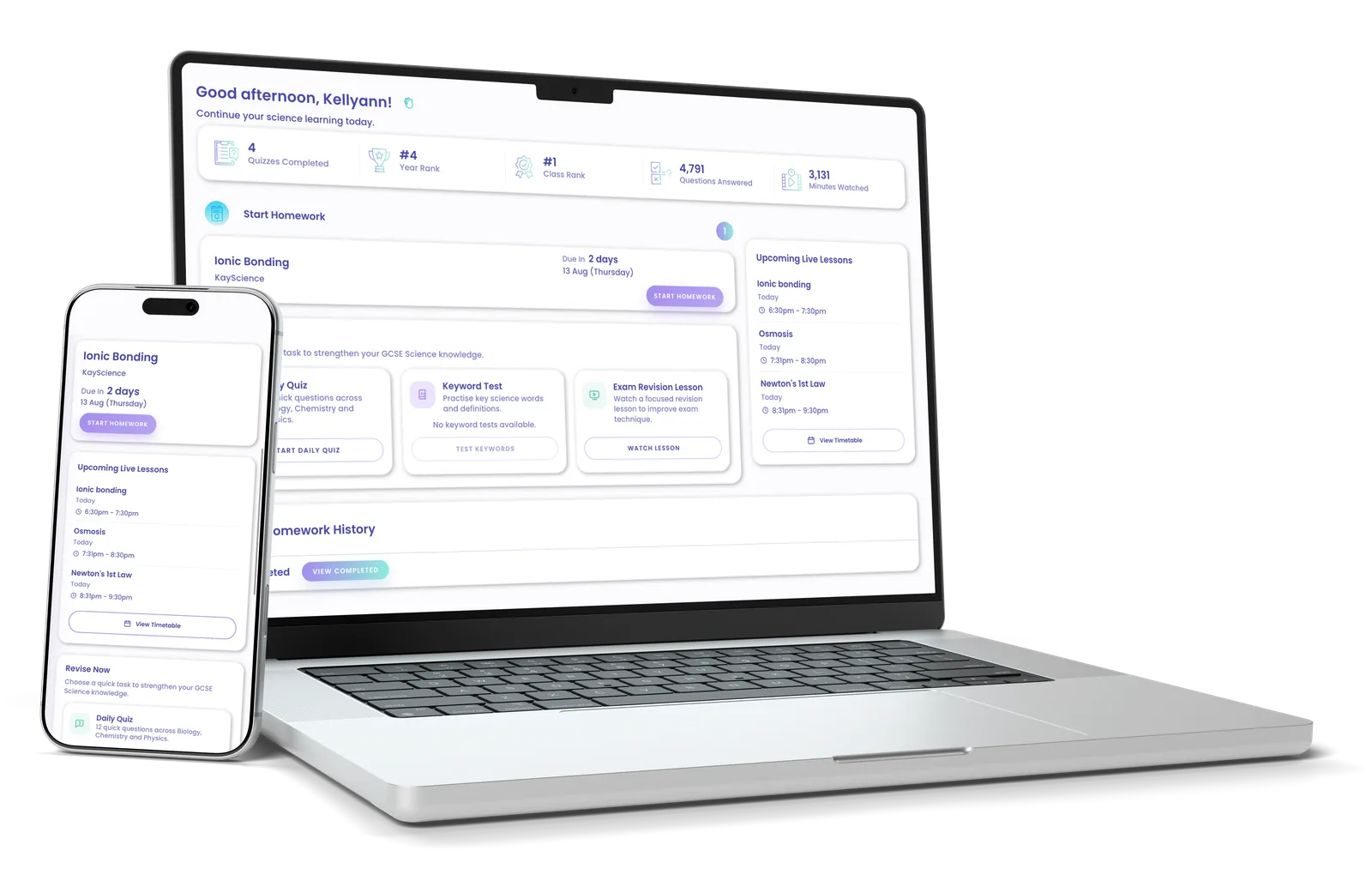
GCSE science revision videos
If your child is relying on GCSE science revision videos but not improving, the problem is not the videos—it is that passive watching does not translate into exam performance. Students often understand what they watch, but cannot reproduce it in exam conditions, leading to lost marks.
Across AQA, Edexcel and OCR, success in GCSE science depends on how answers are written and structured, not just whether a student has seen the content before.
Students can use high-quality content through the [GCSE Science Revision Hub], but videos alone are not enough to improve exam results.
Why This Happens (GCSE science revision videos)
From an examiner’s perspective, students who rely heavily on videos often:
-
recognise topics but cannot recall them independently
-
struggle to apply knowledge to unfamiliar questions
-
give short or underdeveloped answers
-
lack precision in scientific terminology
This creates a gap between understanding and performance.
A typical classroom scenario:
A student watches a full lesson on required practicals and feels confident, but when asked to explain the method in an exam, they miss key steps or terminology.
A common misconception is:
“If I understand the video, I’ll get the marks.”
In reality, GCSE exams reward independent recall, structured explanations and precise wording.
Where Marks Are Being Lost
Students relying on videos tend to lose marks in:
-
4–6 mark extended-response questions
-
required practical questions
-
application-based questions
Example GCSE Question (Biology)
Explain how enzymes are affected by temperature. (4 marks)
Typical Answer
“Enzymes work faster when it’s warmer but stop working if it’s too hot.”
Why this loses marks
This answer:
-
lacks detail
-
misses key scientific terms
-
does not explain the process fully
Stronger Answer
“As temperature increases, enzyme activity increases because particles have more kinetic energy, leading to more frequent collisions. However, at high temperatures, enzymes denature, changing the shape of the active site so the substrate no longer fits.”
Mark scheme insight
To reach full marks, answers must:
-
include multiple linked ideas
-
use correct terminology (denature, active site)
-
clearly explain cause and effect
Students who rely only on videos often give basic explanations rather than full, exam-ready answers.
Practising responses using [GCSE Science Exam Questions] is essential to bridge this gap.
Why Independent Revision Often Fails
Videos are useful, but they encourage passive learning.
Students often:
-
watch multiple videos without testing themselves
-
feel familiar with content but cannot recall it
-
avoid practising exam questions
This leads to:
-
false confidence
-
repeated mistakes
-
weak exam performance
Even high-quality platforms like BBC Bitesize or YouTube cannot provide:
-
personalised feedback
-
correction of mistakes
-
structured progression
Without these, improvement is limited.
What Actually Improves GCSE Science Grades
To turn revision into results, students need to move from passive watching to active practice.
Effective strategy:
-
Use videos as a starting point
-
learn the concept
-
-
Immediately apply knowledge
-
answer exam questions
-
-
Check answers using mark schemes
-
identify missing points
-
-
Practise structured responses
-
focus on 4–6 mark questions
-
-
Repeat and refine
-
improve accuracy and detail
-
Realistic improvement pathway
-
Watch → understand concept
-
Apply → answer exam question
-
Check → identify gaps
-
Improve → refine answer
Students who follow this approach typically gain 10–20 additional marks per paper, often improving by one or two grades.
How Structured Online GCSE Science Tuition Fixes This
Videos alone cannot provide the structure needed for exam success.
Structured tuition provides:
-
guided use of revision videos
-
immediate feedback on answers
-
correction of misconceptions
-
explicit teaching of exam technique
This ensures students:
-
move from understanding to application
-
improve weak areas efficiently
-
build consistent exam performance
With Year 11 mock exams approaching, relying solely on videos is risky. Students who continue passive revision often plateau, while those using structured, feedback-driven approaches improve quickly.
For parents looking for a more effective approach, [GCSE Science Tuition] provides structured support that combines teaching, practice and feedback to improve exam results.
Start revising today
800+ video lessons, quizzes and exam questions for GCSE Science.
Start Your Free Trial