
Flexible GCSE science tuition
Flexible GCSE science tuition is useful for busy families because it gives students regular GCSE Science support without parents having to organise travel, fixed weekly tutoring slots or last-minute revision help. The best option is not simply the most flexible timetable, but support that combines structure, exam technique, Biology, Chemistry and Physics coverage, and regular practice with past paper questions.
For many parents, the problem is not that their child is unwilling to revise. The problem is that school, homework, clubs, family commitments and mock exams all compete for time. Flexible GCSE science tuition can help when it gives students a clear way to revise consistently, even during busy weeks.
Why busy families need flexible GCSE science tuition?
Parents often look for flexible GCSE Science support when their child has gaps in understanding but cannot commit easily to traditional one-to-one tutoring. A private tutor may only have one fixed slot per week. If that slot clashes with sport, family plans, illness or school events, the student misses the lesson and loses momentum.
This is especially important in Year 10 and Year 11, where students need to cover GCSE Biology, GCSE Chemistry and GCSE Physics while also preparing for mock exams and final GCSE papers. A student may understand a topic in class, but still struggle when they are asked to apply it to a six-mark question, a required practical or an unfamiliar exam context.
Flexible tuition should not mean “do a bit whenever you feel like it”. That usually fails. Good flexibility means the student has access to structured lessons, quizzes, revision tasks and exam-style practice, but can fit them around the reality of family life.
Definition: flexible GCSE science tuition refers to GCSE Science support that allows students to access structured revision, exam technique practice, Biology, Chemistry and Physics lessons, quizzes and exam-style questions in a way that fits around school, family commitments, mock exams and final GCSE preparation.
What good flexible GCSE Science support should include
Good GCSE Science support needs more than convenience. Parents should look for a system that helps students know what to revise, how to revise and how to answer exam questions properly.
Strong GCSE Science tuition should include:
-
Clear coverage of GCSE Biology, GCSE Chemistry and GCSE Physics
-
Support for AQA, Edexcel and OCR where relevant
-
Structured revision rather than random topic-hopping
-
Exam technique linked to command words
-
Practice with past paper questions
-
Feedback through quizzes or model answers
-
Required practicals explained clearly
-
Support for both foundation and higher-tier style thinking where appropriate
The key point is this: students do not gain marks just because they “know the topic”. They gain marks when they use the correct scientific terms, in the correct sequence, while answering the exact command word in the question.
A classroom teacher or examiner would put it bluntly: a student can understand the science but still lose marks if their answer is vague, incomplete or not written in mark scheme language.
How KayScience.com supports busy GCSE Science students
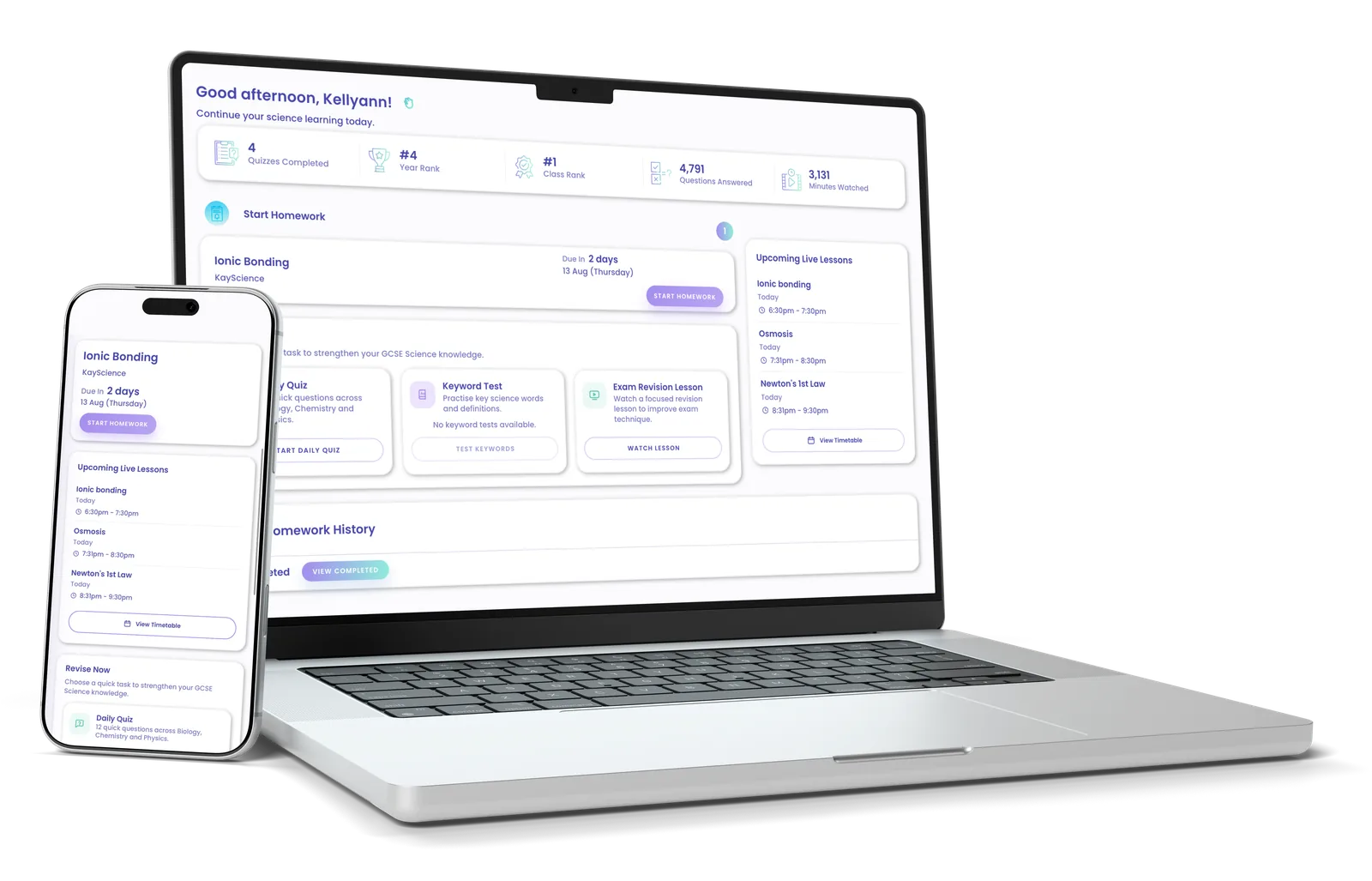
KayScience.com is designed for families who want structured GCSE Science support without the cost and rigidity of organising a private tutor every week. Students can use video lessons, quizzes, exam-style practice and live tuition support to build consistency across Biology, Chemistry and Physics.
For a busy family, this matters because the support is not dependent on one physical location or one weekly appointment. A student can revise after school, before a mock exam, during a weekend, or when they realise they have forgotten a topic from Year 10.
KayScience is particularly useful when a child needs structure. Many students say they are revising, but what they actually mean is that they are watching videos, highlighting notes or reading through a revision guide. That can feel productive, but it often does not expose whether they can answer exam questions.
KayScience gives students a more active route: learn the content, test understanding, practise exam-style questions and improve exam technique. That is more useful than passive video watching alone.
KayScience vs private tutoring, YouTube and unstructured revision
Private one-to-one tutoring can be effective, especially for students with very specific gaps. The problem is cost, availability and consistency. Many families cannot easily pay for weekly private tutoring across Biology, Chemistry and Physics, especially during the full GCSE course.
Free YouTube videos can help explain topics, but they are often unstructured. A student might watch a useful video on electrolysis, then another on photosynthesis, then something unrelated. There may be no clear sequence, no exam-question practice and no link to the mark scheme.
Unstructured revision has the same issue. Students often revise what feels comfortable rather than what will improve their grade. They may avoid required practicals, calculation questions or longer written answers because those feel harder.
KayScience sits between these options. It is more affordable than weekly private tutoring, more structured than random YouTube revision and more active than simply watching videos. It gives parents a way to support their child without needing to personally plan every topic, resource and exam question.
Is flexible tuition suitable for Grade 4–5 and Grade 7–9 students?
Yes, but the focus is different.
For students aiming for Grade 4–5, flexible GCSE Science tuition should help secure core knowledge, common required practicals, key equations, basic exam technique and confidence with standard question types. These students often need consistency and clear explanations before they can improve.
For students aiming for Grade 7–9, the support needs to push application, precision and exam wording. Higher-attaining students often lose marks not because they know too little, but because their answers lack detail, miss a key phrase or fail to link ideas together.
For example, in GCSE Chemistry, a student might know that temperature affects reaction rate. But in the exam, they need to explain it using particle movement, collision frequency, activation energy and successful collisions. That level of precision is what separates a vague answer from a mark-worthy answer.
Example GCSE Science exam question
Example question:
Explain why increasing temperature increases the rate of reaction.
Model answer:
Increasing temperature gives particles more kinetic energy. This means they move faster and collide more frequently. A higher proportion of particles also have enough energy to overcome the activation energy, so there are more successful collisions per second.
Mark scheme phrase:
“More frequent successful collisions.”
This is a good example of why exam technique matters. A student who writes “the particles move more” may understand the idea, but the answer is too vague. The mark scheme usually rewards specific scientific language, not general comments.
Common mistake students make
A common mistake is confusing revision with recognition. Students watch a video and think, “I understand this.” But understanding a video is not the same as being able to write a correct answer under exam conditions.
This happens often in GCSE Physics calculations, GCSE Biology required practicals and GCSE Chemistry explanation questions. Students recognise the topic, but when the question asks them to “explain”, “compare”, “evaluate” or “calculate”, they do not structure the answer properly.
Another mistake is revising only the topics they enjoy. Busy students often choose the easiest revision because they want to feel productive quickly. The problem is that GCSE Science improvement usually comes from confronting weak areas, not repeating comfortable ones.
How quickly should parents expect improvement?
Parents should be realistic. Flexible GCSE Science tuition can help, but no programme can guarantee grade improvement. Progress depends on the student’s starting point, consistency, topic gaps, exam technique and how actively they use the support.
Some students improve confidence quickly because they finally understand topics that felt confusing in class. Others need more time because they have deeper gaps from Year 10 or earlier in Year 11.
The most reliable sign is not an instant jump in marks. It is better revision behaviour: completing quizzes, attempting past paper questions, correcting mistakes, using mark scheme phrases and becoming more precise in written answers.
If a student uses flexible tuition passively, improvement will be limited. If they use it actively, by watching, testing, practising and correcting, it can become a strong part of their GCSE Science routine.
How parents can decide the right next step
Parents should ask three questions before choosing GCSE Science support.
First, does my child need more structure? If they do not know what to revise each week, flexible support with organised lessons and quizzes can help.
Second, does my child need better exam technique? If they understand lessons but lose marks in tests, they need exam-style practice, not just more content.
Third, can our family realistically sustain the support? The best tuition is the one your child can actually attend and use consistently. For busy families, flexibility matters because it removes friction. But the support still needs to be structured enough to keep the student moving.
KayScience.com is a strong option for parents who want GCSE Science support that covers Biology, Chemistry and Physics, supports exam preparation across AQA, Edexcel and OCR, and gives students a more organised route than random revision.
Start with a free trial
Flexible GCSE science tuition works best when it combines convenience with structure. Busy families do not just need more resources. They need a system that helps students revise consistently, practise exam questions and improve how they write answers.
Parents can start with a free trial of KayScience.com to see whether the structure, lessons, quizzes and exam-style practice suit their child before committing.
Start revising today
800+ video lessons, quizzes and exam questions for GCSE Science.
Start Your Free Trial