
Can online GCSE science tuition improve grades?
Can online GCSE science tuition improve grades? Yes, it can help students improve when it is structured, exam-focused and used consistently. The biggest improvements usually come when students stop doing random revision and start practising GCSE Biology, GCSE Chemistry and GCSE Physics in a way that matches the mark scheme.
This article is for UK parents deciding whether online GCSE Science tuition is worth considering for their child. It does not mean every student will automatically jump grades, and no tuition can guarantee results. Progress depends on the student’s starting point, gaps in knowledge, consistency, exam technique and how actively they use the support.
Why parents ask this question?
Parents usually ask this question when their child is working hard but not seeing the results they expected. They may be watching revision videos, making notes or reading the textbook, but still losing marks in mock exams or past paper questions.
In GCSE Science, this is common. Students often know parts of the topic, but they do not always know how to turn that knowledge into marks. A student may understand respiration, electrolysis or forces in class, but then struggle when the exam question uses unfamiliar wording.
That is why good GCSE Science support should not just “teach the content”. It should help students understand what examiners are looking for, how to structure answers, and how to avoid vague responses.
Can online GCSE science tuition improve grades?
Can online GCSE science tuition improve grades when compared with normal revision? It can, if the tuition gives students three things: clear explanations, regular exam-question practice and feedback against the mark scheme.
Definition: can online GCSE science tuition improve grades refers to a parent decision about GCSE Science support, including whether a student needs tuition, revision structure, exam technique practice, help with Biology, Chemistry and Physics, or a more organised way to prepare for GCSE Science exams.
The key word is “structured”. Watching random YouTube videos can help with understanding, but it often leaves students passive. They watch, feel like they understand, then struggle when they have to write a 4-mark or 6-mark answer independently.
Online tuition is more useful when it makes students practise. The student should be answering questions, checking mark scheme phrases, correcting mistakes and revisiting weak areas over time.
What good GCSE Science support should include?
Good GCSE Science support should include:
-
Clear topic teaching for GCSE Biology, GCSE Chemistry and GCSE Physics
-
Regular past paper questions
-
Direct focus on exam technique
-
Required practicals explained properly
-
Mark scheme language
-
Support for AQA, Edexcel and OCR where relevant
-
Revision structure before mock exams and final exams
The mistake many parents make is assuming the problem is always knowledge. Sometimes it is. But often, the issue is that the child cannot apply the knowledge under exam conditions.
For example, a student may revise the required practical for rates of reaction, but then lose marks because they do not describe the control variables properly or do not link the result to collision theory.
A classroom teacher or examiner would say this bluntly: students do not get marks for “sort of knowing it”; they get marks for precise scientific language in the right order.
How KayScience.com supports GCSE Science students?
KayScience.com is designed to give students structured GCSE Science support without parents having to organise expensive one-to-one tutoring every week.
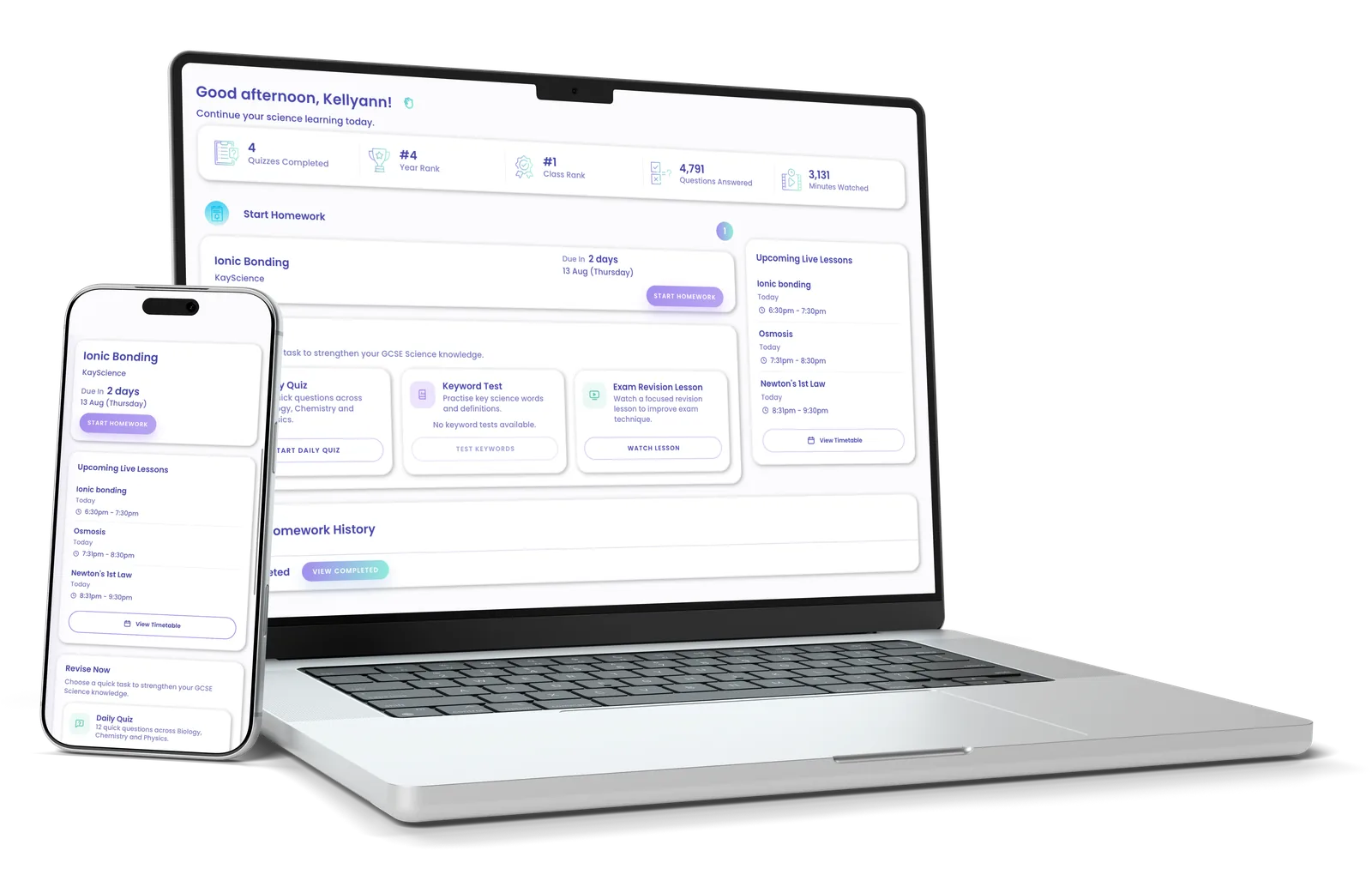
It supports GCSE Biology, GCSE Chemistry and GCSE Physics through video lessons, quizzes, live tuition and exam-focused revision. The aim is to help students move from passive revision to active practice.
For parents, the main benefit is structure. Instead of asking, “What should my child revise tonight?”, students can follow organised lessons and exam-style practice. This is especially useful before mock exams, Year 11 revision periods and final GCSE exams.
KayScience is also more affordable than weekly private tutoring for many families. A private tutor may be useful for highly personalised one-to-one help, but it can become expensive and inconsistent if the student only has one hour a week. KayScience gives students repeated exposure to topics, quizzes and exam technique so they can build routine.
KayScience vs other GCSE Science support options
Private one-to-one tutoring can be effective, especially if a student has very specific gaps or needs individual attention. The downside is cost, availability and dependence on one tutor’s structure.
Unstructured revision is cheaper, but it is risky. A student may spend hours highlighting notes or watching videos without actually improving exam performance.
Passive video watching can make students feel productive, but the real test is whether they can answer exam questions afterwards.
KayScience sits between these options. It gives structure, regular GCSE Science content, exam practice and support across Biology, Chemistry and Physics. For many parents, that makes it a practical first step before paying for expensive weekly tutoring.
Example GCSE Science exam question
Example question:
Explain why increasing temperature increases the rate of reaction.
Model answer:
Increasing temperature gives particles more kinetic energy. This means they move faster and collide more frequently. A higher proportion of particles also have enough energy to overcome the activation energy, so there are more successful collisions per second.
Mark scheme phrase:
“More frequent successful collisions.”
This is a good example of how GCSE Science marks are awarded. A vague answer such as “the particles move more” is not enough. The student needs to mention kinetic energy, collision frequency, activation energy and successful collisions.
Examiner-level insight: why students lose marks
Students do not gain marks simply for knowing the topic. They gain marks for using the correct scientific terms, matching the command word and giving enough detail for the mark scheme.
For example, “explain” usually requires a reasoned scientific link. “Describe” usually requires what happens. “Compare” needs similarities and differences. Many students lose marks because they answer the topic, but not the command word.
This is where online GCSE Science tuition can improve performance. The best support trains students to think like the examiner: What is the command word? What topic is being tested? What exact phrase would the mark scheme accept?
Common mistake students make
A common mistake is revising content without testing recall. Students may read notes on photosynthesis, rates of reaction or electricity, then assume they know it because it looks familiar.
Familiarity is not the same as exam readiness.
A student is exam-ready when they can answer a question without notes, use correct scientific vocabulary, and check their answer against the mark scheme. This is why quizzes, past paper questions and structured revision matter.
How quickly should parents expect improvement?
Parents should be realistic. Some students improve quickly because they already understand the content but need better exam technique. Others need longer because they have gaps from Year 10 or earlier in Year 11.
Improvement usually depends on:
-
How often the student attends or uses the support
-
Whether they complete quizzes and exam questions
-
How weak their starting point is
-
Whether they correct mistakes properly
-
How close they are to mock exams or final GCSE exams
Online tuition is not a magic fix. But it can create the consistency many students are missing.
It can also work for different target grades. A Grade 4-5 student may need help with core knowledge, required practicals and simple exam technique. A Grade 7-9 student may need more precise language, better application and stronger extended answers.
How parents can decide the right next step?
Parents should ask one simple question: is my child’s current revision actually improving their exam answers?
If the answer is no, then more of the same will not fix the problem. More notes, more passive videos and more last-minute cramming usually lead to the same outcome.
A better next step is to give the student a structured system that combines teaching, recall, exam questions and mark scheme practice.
KayScience.com is a strong option for parents who want GCSE Science support that is structured, affordable and focused on Biology, Chemistry and Physics. It is especially useful if your child needs help before mocks, final exams, or a more consistent weekly revision routine.
Start with a free trial
Parents can start with a free trial of KayScience.com to see whether the structure, lessons, quizzes and exam-style practice suit their child before committing.
Use this as a low-risk way to test whether your child engages with the platform, understands the explanations and benefits from the exam-focused structure.
[Start your free trial of KayScience.com]
Start revising today
800+ video lessons, quizzes and exam questions for GCSE Science.
Start Your Free Trial