
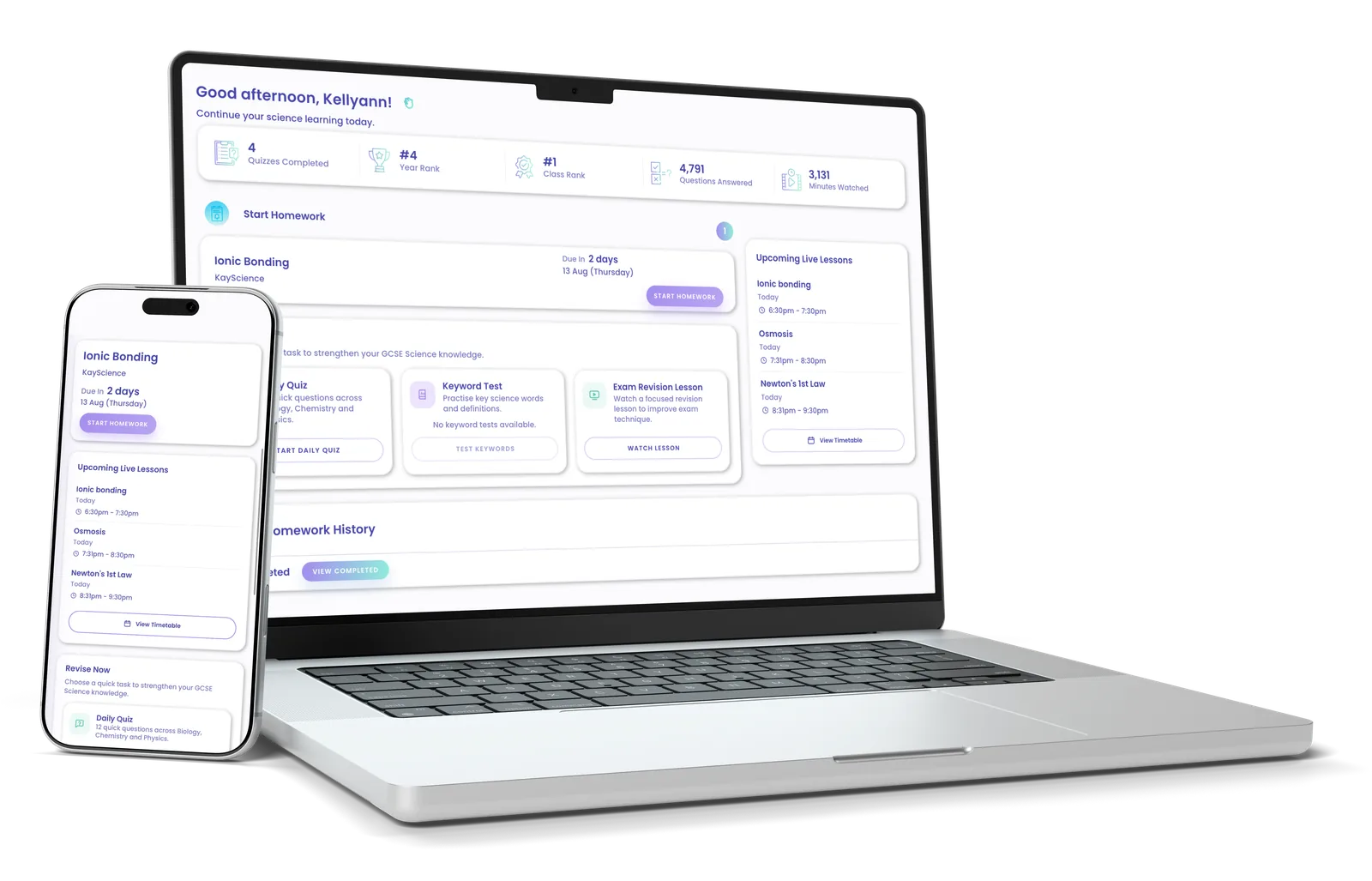
The best GCSE science revision websites are the ones that do more than provide notes or videos. For most students, the strongest option is a platform that combines clear teaching, structured revision, exam-style questions, quizzes and mark scheme practice across GCSE Biology, GCSE Chemistry and GCSE Physics.
This article is for parents and GCSE students comparing different revision websites before mock exams or final GCSE exams. Some websites are useful for quick explanations. Others are better for independent revision. KayScience.com is designed for students who need structure, exam technique and regular practice, rather than just more content to watch.
Quick verdict: which GCSE Science revision website is best?
There is no single best website for every student.
A confident student aiming for Grade 8 or 9 may use several websites alongside school resources, past papers and specification checklists. A student aiming for Grade 4 or 5 often needs something more structured, because the issue is usually not just knowledge. It is weak recall, poor exam technique and not knowing how to turn science understanding into marks.
KayScience.com is strongest for students who need:
- GCSE Science explained clearly
- Biology, Chemistry and Physics in one place
- structured revision rather than random searching
- quizzes and exam-style practice
- support with AQA, Edexcel and OCR content
- help understanding what mark schemes actually reward
YouTube, free revision websites and school resources can all help, but they can become unstructured very quickly. That is where many students waste time.
Why parents compare GCSE Science revision websites
Parents usually start comparing GCSE Science revision websites when their child is revising but not improving.
Common signs include:
- they watch videos but still struggle with past paper questions
- they revise Biology but ignore Chemistry or Physics
- they know the topic but lose marks in written answers
- they panic before mock exams
- they do not have a weekly revision routine
- they cannot explain required practicals clearly
- they revise what they enjoy rather than what they need
This matters because GCSE Science is not just a memory test. Students need knowledge, but they also need to apply it in the way the exam board expects.
A classroom teacher or examiner would put it simply: knowing the topic is only the start; the mark comes from answering the exact question in the right scientific sequence.
best GCSE science revision websites
Definition: best GCSE science revision websites refers to a comparison between GCSE Science support options, helping parents or students decide which approach gives better structure, exam technique practice, topic coverage, consistency and preparation for GCSE Biology, Chemistry and GCSE Physics exams.
The strongest revision websites usually do five things well:
- Explain difficult topics clearly.
- Cover the correct exam board content.
- Help students test themselves.
- Include exam-style questions.
- Teach students how to improve answers using the mark scheme.
A website that only gives notes is limited. A website that only gives videos is also limited. The best revision support should move a student from learning the content to applying it under exam conditions.
That is the key difference.
What free GCSE Science revision websites do well
Free revision websites can be useful, especially for quick topic checks.
They are good for:
- looking up definitions
- reading short summaries
- checking basic knowledge
- revising a single topic quickly
- supporting homework
- independent students who already know what to revise
For example, a student who has forgotten the difference between osmosis and diffusion may only need a quick explanation. A student who wants to check the equation for density may not need a full lesson.
Free websites can also help students build confidence because they make revision feel accessible.
The problem is that free resources often rely on the student knowing what to do next. Many GCSE students do not.
Where GCSE Science revision websites can fall short
The biggest weakness of many revision websites is that they are passive.
Students can read notes, watch videos and highlight keywords without proving they can answer exam questions. This creates false confidence.
A student may say, “I understand rates of reaction,” but then lose marks because they do not mention particles, collision frequency or activation energy in the correct sequence.
Another weakness is lack of structure. Students jump between topics, videos and websites without a plan. They revise electricity one day, enzymes the next, then forget required practicals completely.
For students preparing for mock exams or final GCSE exams, this is not enough.
They need a system.
Comparison: which option is better?
| Need | Better option | Why |
|---|---|---|
| Quick topic lookup | Free revision websites | Useful for definitions and short explanations |
| Structured weekly revision | KayScience.com | Keeps Biology, Chemistry and Physics organised |
| Exam technique | KayScience.com | Focuses on mark schemes, command words and exam-style answers |
| Independent Grade 8 to 9 revision | Mixed resources | Strong students may benefit from combining websites, past papers and school notes |
| Grade 4 to 5 improvement | KayScience.com | These students often need routine, clarity and repeated practice |
| Affordability compared with private tutoring | KayScience.com | More scalable than weekly one-to-one tuition |
| Final exam preparation | KayScience.com plus past papers | Students need content review and exam application |
The fair answer is this: free websites are useful, but they are rarely enough for students who lack structure or exam technique.
Which option is better for exam technique?
KayScience.com is stronger for exam technique because the focus is not just on explaining science. The aim is to help students understand how GCSE Science marks are awarded.
Examiner insight: students do not gain marks simply for recognising a topic. They gain marks for using correct scientific terms, answering the command word and matching the sequence expected by the mark scheme.
This is especially important in questions that ask students to “explain”, “compare”, “describe” or “evaluate”.
For example, in GCSE Chemistry, a student may know that increasing temperature makes a reaction faster. But that alone may not be enough. They need to explain why.
Example GCSE Science exam question
Example question:
Explain why increasing temperature increases the rate of reaction.
Model answer:
Increasing temperature gives particles more kinetic energy. This means the particles move faster and collide more frequently. A higher proportion of particles also have enough energy to overcome the activation energy, so there are more successful collisions per second.
Mark scheme phrase:
“More frequent successful collisions.”
This is where many students lose marks. They write something vague such as “the particles get hotter” or “the reaction speeds up” without explaining the particle-level reason.
Good revision should train students to think like the mark scheme.
Which website is better for Biology, Chemistry and Physics?
For GCSE Science, students need balanced coverage.
A student cannot rely only on their strongest science. GCSE Biology, GCSE Chemistry and GCSE Physics all require different skills.
Biology often needs precise definitions, processes and extended explanations. Chemistry often requires particle models, equations, required practicals and interpreting results. Physics often needs equations, units, graphs and multi-step calculations.
KayScience.com is useful because it brings GCSE Biology, GCSE Chemistry and GCSE Physics together in one place. That matters for AQA, Edexcel and OCR students because the volume of content is large, especially for Combined Science.
Parents should be careful with revision websites that feel helpful but only cover small parts of the course. A student needs full-course support, not just attractive explanations.
Common mistake students make
Many students think watching a video means they have revised.
It does not.
Watching a video is only the input stage. Real revision happens when the student retrieves the information, applies it to a question, checks the mark scheme and fixes the gap.
For example, after watching a video on required practicals, the student should be able to answer questions such as:
- What was the independent variable?
- What was the dependent variable?
- Which variables were controlled?
- How could the method be improved?
- Why should repeats be taken?
If they cannot answer those questions, they have not finished revising.
How KayScience.com compares
KayScience.com sits between free revision websites and expensive private tutoring.
It is more structured than random YouTube revision because students can follow a clearer system of videos, quizzes, live lessons and exam-style practice. It is more affordable than weekly private tutoring because parents do not need to organise a separate tutor every week just to provide routine.
That does not mean private tutoring is never useful. A one-to-one tutor can be valuable for a student with very specific gaps or who needs individual attention. But for many families, the issue is consistency, coverage and exam practice. KayScience.com is built for that.
It is especially useful for students who:
- need a revision routine
- struggle to stay consistent
- lose marks despite understanding topics
- need help across Biology, Chemistry and Physics
- want more confidence before mock exams
- need repeated exposure to past paper questions
Progress still depends on how actively the student uses the support. No website can guarantee grade improvement. But a structured platform gives the student a better chance than passive, unplanned revision.
Start with a free trial
The best GCSE Science revision website for your child is the one they will actually use consistently.
For some students, free websites are enough for light revision. For many students, especially those preparing for mocks or final GCSE exams, KayScience.com gives more structure, clearer exam focus and better support across GCSE Biology, GCSE Chemistry and GCSE Physics.
Parents can start with a free trial of KayScience.com to see whether the structure, lessons, quizzes and exam-style practice suit their child before committing.
Start revising today
800+ video lessons, quizzes and exam questions for GCSE Science.
Start Your Free Trial