
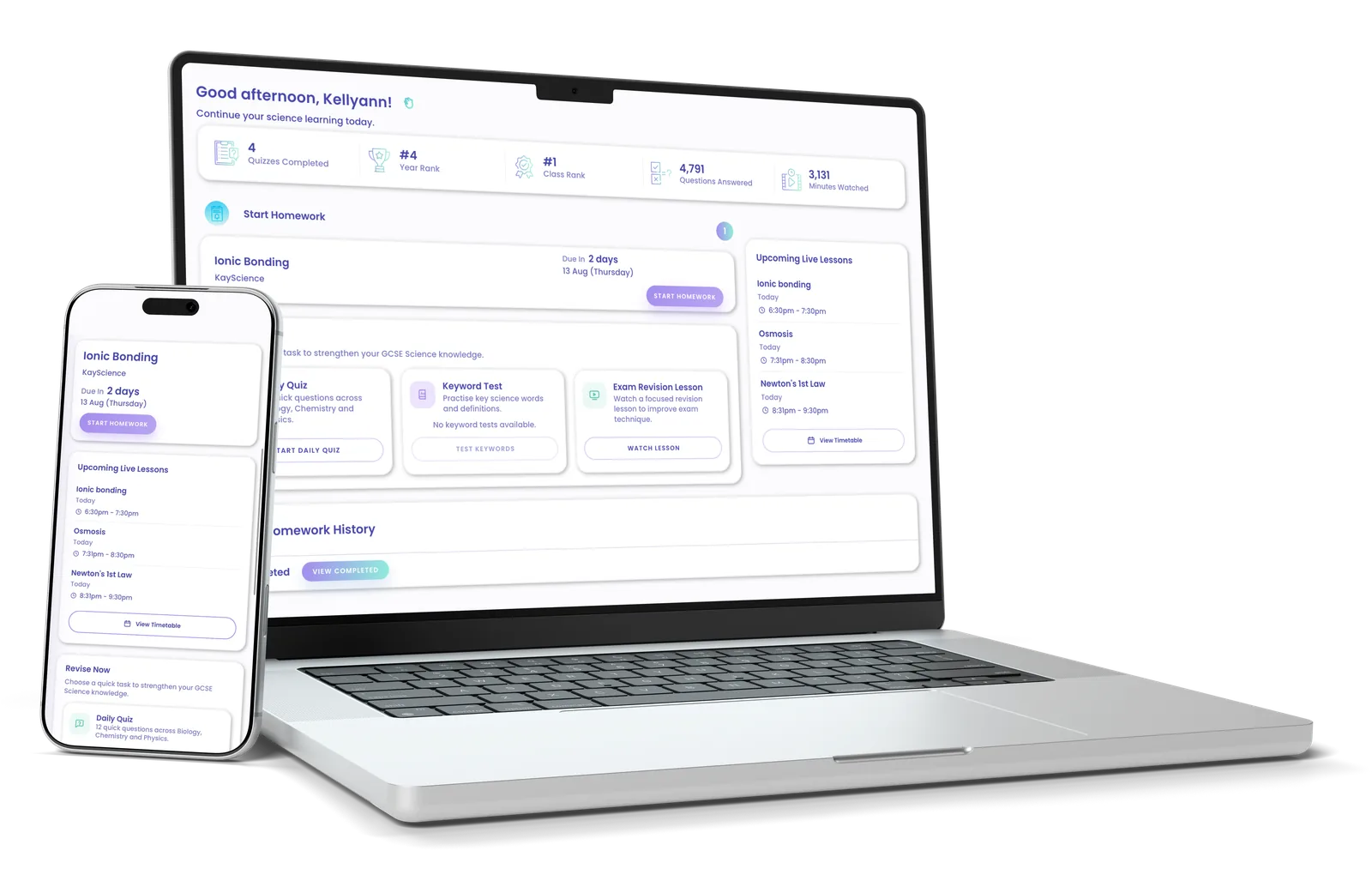
Affordable GCSE science tuition should give your child focused support in GCSE Biology, GCSE Chemistry and GCSE Physics without the cost and inconsistency that often come with traditional one-to-one tutoring. The best option is not simply the cheapest. It is the one that improves grades, strengthens exam technique and gives clear structure before mock exams and final papers.
For parents comparing options, affordable GCSE science tuition is usually best when it combines curriculum-matched teaching, exam-style practice, progress tracking and flexible access at a lower monthly cost than private tutoring. That is where a structured platform can outperform expensive hourly sessions, especially for Year 11 students working towards better mock exam results.
A strong tuition option should not just reteach content. It should help students answer questions the way exam boards reward, build confidence across topics and turn revision into measurable progress. Early access to [GCSE Science Revision Hub] also matters because it gives students somewhere to revise between lessons, not just during them.
Definition: GCSE science tuition is structured academic support that teaches subject knowledge and exam technique aligned with AQA, Edexcel and OCR specifications.
What to Look For in GCSE Science Tuition
Parents often compare price first, but price alone is a weak measure of value. A lower-cost option is only worthwhile if it helps students improve understanding, recall key facts and perform better under exam conditions.
Look for these features when comparing GCSE science support:
-
Clear coverage of GCSE Biology, GCSE Chemistry and GCSE Physics
-
Teaching matched to AQA, Edexcel and OCR specifications
-
Strong focus on exam technique, not just content delivery
-
Practice using exam questions and mark scheme logic
-
Support with required practicals and common application questions
-
Access to revision resources outside lesson time
-
Progress tracking across topics and mock exams
This matters because GCSE science marks are often lost through poor answer structure, weak command-word understanding and gaps in applying knowledge. A student may know the topic but still miss marks if they do not answer in the format the examiner expects.
Parents should also check whether the tuition model is consistent. A system that offers repeatable lesson quality, regular revision support and easy access at home usually creates more reliable outcomes than a tutor who varies from week to week.
Academic Credibility – How affordable GCSE science tuition Exams Are Marked
In GCSE science, the mark scheme matters as much as the topic. Examiners do not award marks for vague scientific awareness. They award marks for precise points, correct terminology and answers that match the command word.
Here is a simple GCSE exam question example:
Question: Describe how particle arrangement changes when a substance goes from a liquid to a gas. (3 marks)
A strong answer would include:
-
particles become more spread out
-
particles move more freely
-
intermolecular forces are weaker than in the liquid state
This is where students often go wrong. They write that the particles “disappear” or “break apart,” which is incorrect. In GCSE Chemistry, weak wording loses marks even when the student broadly understands the idea.
Examiner insight: for extended and short-response questions, marks are usually awarded for specific science points, not for how long the answer is. A concise answer with three correct marking points will usually score better than a long paragraph full of imprecise language.
That is why effective tuition must teach students how to decode command words such as describe, explain, compare and evaluate. It must also expose them to [GCSE Science Exam Questions] so they practise under realistic conditions, using the same style they will face in mock exams and final papers.
Private Tutor vs Structured Online Tuition
A private tutor can work well, but the model has clear weaknesses. Quality varies heavily between tutors, availability is limited and pricing can become difficult to justify if your child needs ongoing support across all three sciences.
Structured online tuition is different. It gives students a consistent teaching method, repeated access to lessons and revision tools, and support that can scale across GCSE science rather than only covering one topic at a time.
Here is the practical difference:
Private tutor
Usually charges by the hour, often between sessions with limited follow-up. The experience depends almost entirely on one individual.
Structured online tuition
Usually gives broader subject coverage, repeated access to content, exam question practice and a lower monthly cost. It is often a better fit for families who want both value and continuity.
For many parents, the issue is not whether tutoring works. It is whether the cost of one-to-one support is justified when a structured online model can provide frequent science teaching, revision resources and exam preparation in one place.
Pricing and Value of GCSE Science Tuition
The right question is not “What is the cheapest option?” It is “What do we actually get for the money?”
A low-cost service that only offers videos has limited value. A higher-value affordable option should include teaching, structured revision, exam technique, exam-style questions and regular access that your child can use around school and homework demands.
When assessing value, ask:
-
Does it cover all three sciences?
-
Does it support AQA, Edexcel and OCR learners?
-
Does it include revision for required practicals?
-
Does it help with mock exams and real exam technique?
-
Can my child use it more than once a week?
-
Is there a clear route into [GCSE Science Tuition] if they need more support?
This is where structured online GCSE science tuition becomes commercially stronger than hourly tutoring. Instead of paying for one fixed hour, parents are paying for a wider support system. That usually improves cost efficiency and helps students revise more regularly.
A quantified benefit matters too. If a student uses a platform several times per week across Biology, Chemistry and Physics, the effective cost per learning session drops sharply compared with paying for separate tutor appointments. That can mean access to dozens of targeted revision sessions and exam walkthroughs across a term, rather than only four or five isolated lessons.
Why Structured Online GCSE Science Tuition Makes the Difference
Structured tuition works because GCSE science is not just a knowledge problem. It is also a performance problem. Students need to recall content, apply it to unfamiliar questions and write answers that match the mark scheme.
That is especially important in Year 11 when mock exams are approaching and revision time becomes tighter. At that stage, students benefit most from a system that reduces wasted time and tells them what to revise, how to answer and where they are losing marks.
A teacher-led online model is often stronger because it combines clarity with scale. Students can revisit tricky topics, practise questions repeatedly and build better exam habits across the full specification. Parents also get a clearer sense of value because the support is broader than one lesson per week.
The biggest difference is consistency. Students who work through structured lessons, science revision materials and exam question practice each week are more likely to build stable performance than students relying on occasional help. That does not guarantee top grades, but it gives them a stronger system for improving.
A measured next step is simple: review the resources, compare the structure and start with a free trial before committing long term. That lets you judge whether the tuition actually supports your child’s revision routine rather than just sounding good on paper.
FAQs
Is affordable GCSE science tuition good enough for higher grades?
Yes, if it teaches both content and exam technique. Price does not determine quality. Structure, curriculum match and question practice do.
When should Year 11 students start GCSE science tuition?
Ideally before mock exams, not after poor results arrive. Starting earlier gives time to fix weak topics and improve exam habits.
Does GCSE science tuition need to match the exam board?
Yes. Good tuition should reflect AQA, Edexcel and OCR topic coverage, question style and mark scheme expectations.
Start revising today
800+ video lessons, quizzes and exam questions for GCSE Science.
Start Your Free Trial